Avalanche Safety Basics: Beacon, Probe, Shovel and Training
The moment you leave a ski area boundary and skin into untracked snow, the rules change. There is no ski patrol watching the slope, no explosive control work knocking down unstable layers before you arrive, and no one who will come looking unless your own partners do. That is why avalanche safety gear exists, and why the people who use it well treat it as a system rather than a shopping list. This guide walks through the core of that system: the avalanche transceiver (beacon), the probe, and the shovel, along with the airbag pack, the forecast, and the training that ties everything together.
Read this as an honest introduction, not a course. You will finish it understanding what each tool does, why all three ride together on every trip, and why gear alone will never keep you safe. What it cannot do is teach your hands the muscle memory of a real rescue, or your mind the judgment to avoid one in the first place. Only a certified, in-person avalanche course does that. Think of the next few sections as the map that helps you decide where to point your learning, then go get the real training before you ever travel in avalanche terrain.
Why the Backcountry Is a Different World
Inside a ski resort, an enormous amount of invisible work keeps you alive. Avalanche forecasters study the snowpack, patrollers close hazardous terrain, and control teams use explosives to trigger slides on their own schedule, when no one is beneath them. By the time a run opens, the dangerous work is already done. The backcountry offers none of this. The snow is exactly as nature left it, layered with buried weaknesses that can release under a skier’s weight without warning.
This is the heart of the difference: in the backcountry, you and your partners are the patrol, the forecasters, and the rescue team, all at once. A buried person’s survival depends almost entirely on the companions standing next to them, because professional responders are usually too far away to arrive in time. That reality shapes every decision that follows, from the gear you carry to the terrain you are willing to cross.
The Three Essentials: Beacon, Probe, and Shovel
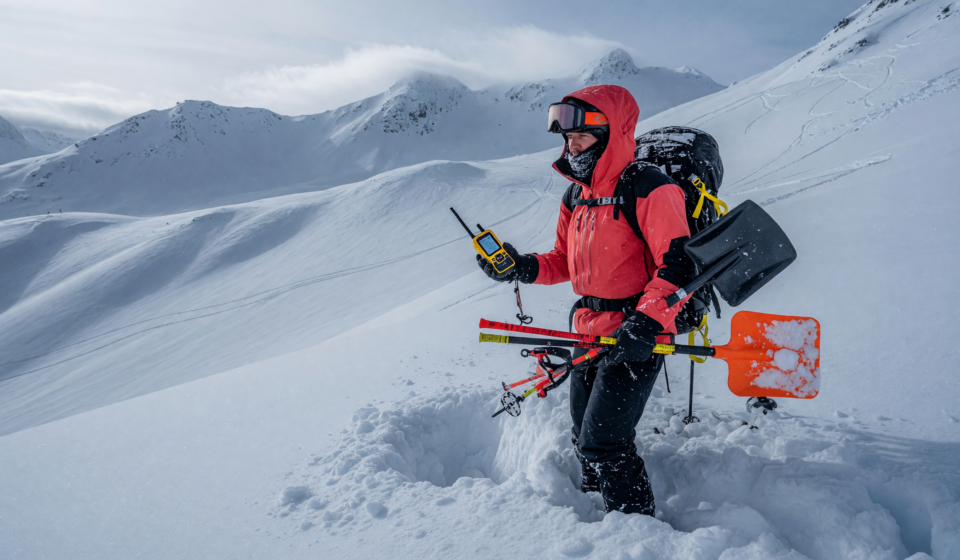
Ask any guide, avalanche educator, or forecaster what you must carry, and you will hear the same three items every time. They are often called “the Big Three,” and they are useless in isolation. A beacon without a shovel cannot dig anyone out; a probe without a beacon has no place to search. They work only as a set, and every single person in the group must carry all three and know how to use them.
- Avalanche transceiver (beacon): A small electronic device worn against your body that transmits a radio signal in “send” mode. If you are buried, it broadcasts your location; if a partner is buried, you switch yours to “search” mode to home in on theirs. All modern beacons operate on the international standard frequency of 457 kHz, so devices from different brands are compatible with one another.
- Probe: A collapsible pole, usually around 240 to 320 centimeters long, that assembles in seconds. Once your beacon narrows the search to a small area, you push the probe into the snow in a methodical pattern to pinpoint the buried person and confirm exactly where and how deep to dig.
- Shovel: A sturdy, metal-bladed collapsible shovel built to move dense avalanche debris, which sets up nearly as hard as concrete. Plastic toy shovels are worthless here. Strategic shoveling is often the slowest, most physically demanding part of a rescue, so a real shovel is not optional.
Carry these three together, keep the beacon on your body rather than in your pack, and check that everyone’s batteries are fresh before you leave the trailhead.
👉 Shop avalanche transceiver/beacon on Amazon (Ad — as an Amazon Associate, we earn from qualifying purchases.)
👉 Shop avalanche probe on Amazon (Ad — as an Amazon Associate, we earn from qualifying purchases.)
👉 Shop avalanche shovel on Amazon (Ad — as an Amazon Associate, we earn from qualifying purchases.)
How the Three Work Together in a Companion Rescue
Understanding what each tool does is only half the picture. The reason all three ride together is that a companion rescue is a single, time-critical sequence, and each tool takes over where the last one ends. When an avalanche buries a partner, the survivors immediately switch every beacon to search mode and move onto the debris, following the strongest signal toward the victim. This is the coarse search, and it covers ground fast.
As the signal strengthens, the searcher slows into a fine search close to the snow surface, then deploys the probe to strike the buried person and lock in their exact position and depth. Only then does the shovel come out, with the team digging strategically from the downhill side rather than straight down. The entire chain, from switching to search mode to breathing air to the victim, must unfold in minutes.
Why speed is everything. Survival odds for a completely buried victim are high in the first several minutes and then fall sharply as burial time grows. Professional rescuers almost never arrive fast enough, so a buried person’s best and often only hope is the trained partner standing a few feet away.
The Airbag Pack: Added Protection, Not a Free Pass
Beyond the Big Three, many backcountry travelers add an avalanche airbag pack. When you pull its trigger handle during a slide, the pack inflates one or two large balloons, roughly 150 liters of volume, around your head and shoulders. The physics are simple: larger objects tend to rise to the surface of moving debris, so inflating your effective size can help keep you closer to the top and reduce the depth of a burial, or prevent one altogether.
An airbag is a valuable layer of protection, but it is not a substitute for anything else. It does nothing to help you locate or dig out a partner, it can fail to fully bury you yet still leave you injured by trauma, and it only works if you actually pull the handle in a chaotic, terrifying moment. Wear it as a complement to your beacon, probe, and shovel, never as a reason to accept riskier terrain.
👉 Shop avalanche airbag pack on Amazon (Ad — as an Amazon Associate, we earn from qualifying purchases.)
Why Training Is Non-Negotiable
Here is the truth that no gear catalog will tell you plainly: the equipment above is close to worthless without the training to use it under pressure. A beacon search is a skill that degrades quickly without practice. Strategic shoveling is a technique, not an instinct. And recognizing dangerous terrain before you commit to it is a discipline that takes structured education and mentorship to develop. This is why national avalanche organizations frame safe travel not as buying gear, but as a three-part commitment: get the forecast, get the gear, and get the training.
In the United States, the standard path is a certified course, most commonly through AIARE (the American Institute for Avalanche Research and Education). An introductory AIARE course, or a dedicated avalanche rescue course, puts a beacon in your hand, sends you into a practice burial field, and teaches you to read terrain and manage risk with a partner. No article, video, or product page can replace that in-person instruction and repetition. If you take one action after reading this, make it signing up for a course.
Reading the Avalanche Forecast Before Every Tour
Some days the backcountry is reasonably safe, and some days it is genuinely dangerous, and you cannot tell which is which by looking out the window. That information comes from your regional avalanche center. Before every single tour, check the forecast for the exact zone and elevation band you plan to travel in. You can find your local center through avalanche.org, the public-facing hub connected to the National Avalanche Center.
A forecast gives you the day’s danger rating on a five-level scale, describes the specific avalanche problems in the snowpack, and points to the aspects and elevations where trouble is most likely. Reading it is a skill in its own right, one that your training will develop, but even a beginner can learn to respect a “considerable” or “high” rating and choose a mellower objective. Checking the forecast is the cheapest, fastest safety step you will ever take, and it costs nothing but a few minutes.
Smart Travel Habits That Keep Groups Alive
Good gear and a good forecast still leave the most important variable in your hands: how you actually move through the mountains. A few habits, drilled until they are automatic, separate seasoned backcountry travelers from lucky ones.
- Never travel alone: A solo buried victim has no one to search for them. A capable partner is your rescue system, so treat traveling with others as a non-negotiable rule.
- Expose one person at a time: On any slope steep enough to slide, cross it one at a time while your partners watch from a safe spot. If something releases, only one person is caught and the rest are ready to respond.
- Choose terrain deliberately: Most avalanches happen on slopes between roughly 30 and 45 degrees. When the danger is elevated, favor lower-angle terrain and avoid slopes with obvious traps below them, like gullies, cliffs, or trees.
- Keep watching and communicating: Regroup only in protected islands of safety, keep eyes on whoever is exposed, and speak up the moment something feels wrong. Sound decisions come from the whole group, not one confident leader.
Building Your Kit and Practicing With It
Assembling your setup is straightforward once you know the priorities. Start with a modern digital beacon, a metal-bladed shovel, and a sturdy probe of at least 240 centimeters, carried in or on a pack you can move in comfortably. Add an airbag pack if your budget and objectives call for it. Fresh batteries, a quick function check at the trailhead, and a beacon worn under your outer layers round out the basics.
Owning the kit is where the work begins, not where it ends. Practice beacon searches in a park or backyard until you can find a buried signal quickly and calmly. Rehearse assembling your probe and shovel with cold hands and gloves on. Run mock rescue scenarios with your regular partners so that, if the worst happens, the sequence is second nature rather than a panicked scramble. Gear you have never practiced with is gear you cannot count on.
The Bottom Line
The beacon, probe, and shovel are the price of admission to the backcountry, and the airbag pack is a worthy addition. But none of it makes you safe on its own. Safety lives in the combination of the right equipment, a forecast you actually read, partners you never leave behind, terrain choices made with respect, and the training that turns all of it into instinct. Buy the gear, then go earn the skills to deserve it. Sign up for a certified course, check the forecast before every tour, and treat the mountains as the serious, beautiful, unforgiving place they are.
Disclaimer: This article is provided for general educational purposes and is NOT a substitute for professional avalanche training. Backcountry travel in avalanche terrain carries a risk of serious injury or death. Always take a certified course before traveling in avalanche terrain, carry a complete rescue kit that every member of your group knows how to use, and consult your regional avalanche forecast before each trip.
Sources: avalanche.org / National Avalanche Center; AIARE (American Institute for Avalanche Research and Education); American Avalanche Association; REI Expert Advice.