Motorcycle Helmets: DOT, Snell and ECE Ratings Explained
Walk into any motorcycle shop or scroll through an online store and you will see a wall of helmets covered in stickers: DOT, Snell, ECE, and a few acronyms you may not recognize. If you have ever wondered whether those labels actually mean anything—or which one you should trust with your skull at highway speed—you are asking exactly the right question. Understanding motorcycle helmet ratings is the difference between buying real protection and buying a plastic cap that looks the part but does nothing when it counts.
This guide breaks down the three certifications that matter most to American riders: the U.S. federal DOT standard, the independent Snell certification, and the European ECE standard that is now widely sold in the States. We will explain how a helmet protects you, what each rating tests, how to choose between helmet styles, how to nail the fit, when to replace a helmet, and how to spot a dangerous “novelty” lid before it ends up on your head.
How a Helmet Actually Protects You
A motorcycle helmet is not just a hard shell. It is a two-part system engineered to manage energy. The outer shell—fiberglass composite, polycarbonate, or carbon fiber—spreads the force of an impact across a wide area and resists penetration from road debris. Beneath it sits a thick layer of expanded polystyrene (EPS), the same stiff foam you find in a bike helmet or a shipping box. That foam is designed to crush on impact, slowing your head over a few extra milliseconds and dramatically reducing the peak forces transmitted to your brain.
That crushing is a one-time event. Once the EPS liner has compressed in a crash, it does not spring back, which is why a helmet that has taken a serious hit must be retired even if the shell looks fine. Modern safety research has also focused heavily on rotational forces—the twisting motion your brain experiences in an angled impact—which is where the newer testing standards have made the biggest strides. A good helmet, correctly fitted and properly certified, is still the single most effective piece of safety gear a rider can own.
The DOT Standard (FMVSS 218): The Legal Minimum
In the United States, the baseline is set by the Department of Transportation through Federal Motor Vehicle Safety Standard No. 218, usually written as FMVSS 218. Any helmet sold for on-road motorcycle use in the U.S. must meet this standard. It defines requirements for impact attenuation, penetration resistance, and the retention system (the chin strap), and it is the legal minimum you are required to wear in states that mandate helmets.
One important nuance: DOT is a self-certification system. Manufacturers test their own helmets and certify compliance, rather than sending every model to an independent lab before sale. NHTSA does purchase helmets off the shelf and test them for compliance after the fact, but there is no mandatory third-party gatekeeper up front. Helmets manufactured on or after May 13, 2013 must carry the updated certification label on the back reading “FMVSS No. 218 CERTIFIED,” along with the manufacturer and model information.
Key point. A genuine DOT label lives on the back of the helmet and states FMVSS No. 218 compliance. A sticker alone is not proof of quality—counterfeit DOT labels exist—but a helmet with no legitimate DOT marking has no business on a public road.
👉 Shop DOT/ECE full-face helmet on Amazon (Ad — as an Amazon Associate, we earn from qualifying purchases.)
Snell M2020 Explained
The Snell Memorial Foundation is a private, nonprofit organization that has been writing its own, independent helmet standards since 1957. Unlike DOT, Snell certification is voluntary and involves true third-party testing: manufacturers pay to have helmets tested, and Snell also pulls certified helmets from the market for ongoing checks. A Snell sticker inside the helmet tells you the model passed a battery of tests that generally exceed the federal floor.
The current motorcycle standard is Snell M2020, and you will see it in two flavors:
- M2020D: Aligned with the U.S. testing approach and the DOT framework, this is the certification you will most often find on street helmets sold in America.
- M2020R: Built around the ECE-based test protocol, this version is common on helmets destined for markets that follow the European standard and on many racing-oriented lids.
The two designations exist because the world runs on two different testing philosophies, and Snell chose to certify against both rather than force a single approach. For a typical U.S. street rider, an M2020D-certified helmet layered on top of DOT compliance represents a genuinely well-vetted piece of equipment.
ECE 22.06 Explained
ECE is the European standard, administered under United Nations Economic Commission for Europe (UNECE) Regulation 22. The latest revision, ECE 22.06, replaced the long-running 22.05 version and represents one of the most demanding production-helmet standards in the world. Because so many premium helmet brands are global, ECE 22.06 helmets are now widely sold in the United States, and many riders specifically seek them out.
What makes 22.06 notable is the breadth of its testing. Where the older standard tested impacts at essentially a single angle, ECE 22.06 evaluates helmets across a wider range of impact points and multiple impact speeds, and—critically—adds oblique (rotational) impact testing to account for the twisting forces that cause many brain injuries. It also tests visors and accessories, and it finally certifies modular helmets in both the open and closed positions, closing a real-world gap from the previous version. Unlike DOT’s self-certification, ECE requires independent type-approval testing before a helmet can be sold in participating markets.
👉 Shop modular helmet on Amazon (Ad — as an Amazon Associate, we earn from qualifying purchases.)
DOT vs. Snell vs. ECE: What Actually Matters
Here is the honest, practical takeaway on motorcycle helmet ratings. DOT is the legal minimum and a non-negotiable baseline for any street helmet in the U.S. Snell and ECE are additional certifications that involve independent, up-front testing—so seeing one of them alongside DOT tells you the helmet cleared a more rigorous, externally verified bar. None of these labels are a substitute for the others; they answer slightly different questions.
- DOT (FMVSS 218): Required by law for U.S. street use; self-certified by the manufacturer with after-market spot checks by NHTSA.
- Snell M2020: Voluntary, independently tested, and updated on a five-year cycle; a strong signal of a manufacturer’s commitment to protection.
- ECE 22.06: Independently type-approved, with modern rotational and multi-angle testing; increasingly the benchmark serious riders look for.
A helmet carrying DOT plus either Snell M2020 or ECE 22.06 has been vetted well beyond the legal floor. Chasing the “one true rating” matters far less than buying from a reputable brand, verifying legitimate certification labels, and—above all—getting a helmet that fits your head correctly.
Helmet Types and How Much They Cover
Certification tells you how well a helmet performs in testing; the style tells you how much of your head it is protecting in the first place. The four main categories offer very different levels of coverage.
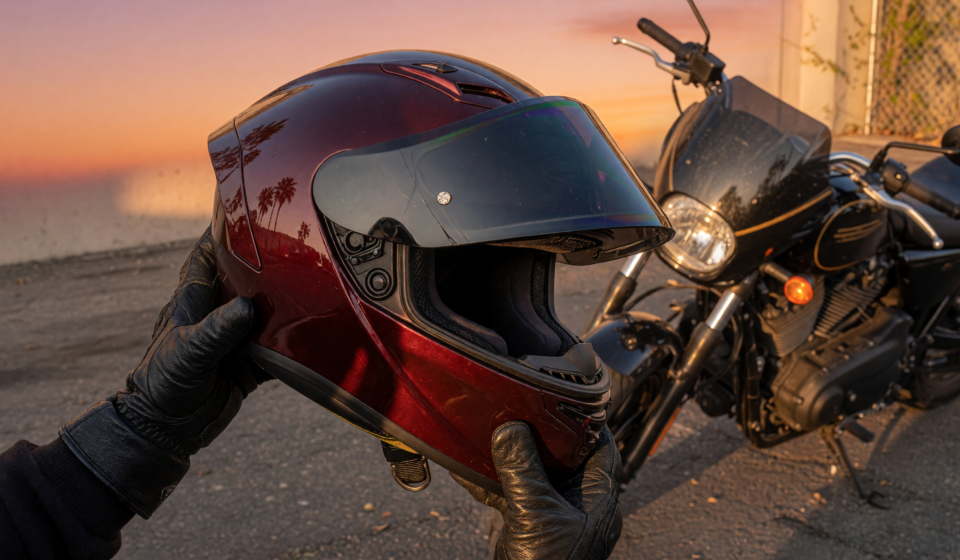
- Full-face: The most protective option, wrapping the entire head and adding a fixed chin bar that shields your face and jaw. Notably, NHTSA reports it has never seen a full-face novelty helmet, making the style itself a reliable indicator of a serious product.
- Modular (flip-up): A full-face design with a chin bar that lifts up, offering convenience at stops and for riders who wear glasses. Look for one certified with the chin bar tested in both positions.
- Open-face (3/4): Covers the top, back, and sides of the head but leaves the face exposed. Popular with cruiser and scooter riders; pair it with goggles or a face shield.
- Half helmet: Covers only the top of the head. It offers the least protection of any legitimate style and no face or jaw coverage at all.
Whatever the style, the certification rules still apply. A properly DOT-certified half helmet is legal; a half helmet with a fake sticker and a paper-thin liner is a novelty item masquerading as safety gear.
Getting the Right Fit
A five-star helmet that fits poorly is a compromised helmet. Protection depends on the liner staying in firm, even contact with your head, so fit is not a comfort afterthought—it is a core part of the safety equation. Start by measuring the circumference of your head with a soft tape, roughly one inch above your eyebrows, and match that measurement to the manufacturer’s size chart rather than guessing from a hat size.
When you try a helmet on, it should feel snug all the way around—firm enough to press gently on your cheeks and forehead without painful hot spots. With the chin strap fastened, try to rotate the helmet and rock it forward and back; your skin should move with it rather than the helmet sliding freely. A helmet that can be rolled off the back of your head is too loose. Remember that the internal padding breaks in slightly with use, so a new helmet should start on the snug side rather than roomy.
👉 Shop Bluetooth communication system on Amazon (Ad — as an Amazon Associate, we earn from qualifying purchases.)
When to Replace, and How to Spot a Novelty Helmet
Replace your helmet immediately after any crash or significant impact, even a drop onto a hard surface from height. The EPS liner is engineered to crush once; once it has absorbed a serious hit, its protective capacity is spent whether or not you can see the damage. Beyond crashes, the industry’s common guidance—echoed by the Snell Memorial Foundation and many manufacturers—is to replace a helmet roughly every five years, because glues, resins, foam, and comfort liners degrade with sweat, UV exposure, and time.
The most dangerous helmets on the road are so-called novelty helmets—thin, lightweight shells sold to skirt FMVSS 218 rather than meet it. NHTSA offers several quick tells for spotting them:
- Weight: A compliant helmet typically weighs about three pounds; many novelty helmets weigh a pound or less.
- Liner thickness: A real helmet has a stiff foam (EPS) inner liner at least three-quarters of an inch thick, not just a thin layer of soft padding.
- Chin strap and rivets: Look for sturdy straps anchored with solid rivets; flimsy hardware is a red flag.
- Labels: A legitimate FMVSS No. 218 label belongs on the back; additional Snell or manufacturer labeling inside adds assurance. Be wary, though, since counterfeit stickers exist.
When in doubt, buy from an established retailer and a recognized brand. A helmet advertised with winking phrases like “for novelty use only” is telling you plainly that it is not built to protect your head.
The Bottom Line
DOT compliance is the legal floor for riding on U.S. roads, and Snell M2020 or ECE 22.06 certification stacks independent, up-front testing on top of that baseline. But the best rating in the world only works if the helmet is a full-coverage style you will actually wear, fits your head snugly, is free of crash damage, and is not a decade past its prime. Verify the labels, choose a reputable brand, prioritize fit, and replace the helmet when it is time. Do that, and you will be wearing the single most valuable piece of gear you own—one that is genuinely earning the ratings printed on its shell.
Disclaimer: This article is provided for general educational purposes only and does not constitute safety, legal, or professional advice. Certification standards and requirements can change over time. Always follow your state helmet laws and the manufacturer’s guidance for fit, use, care, and replacement of any motorcycle helmet.
Sources: NHTSA / FMVSS 218 (DOT); Snell Memorial Foundation (M2020); UNECE Regulation 22.06; NHTSA “How to Identify Unsafe Motorcycle Helmets.”