Tick and Mosquito Protection: EPA Repellents, Permethrin and Checks
You spend a long, satisfying afternoon in the yard or on a wooded trail, and it isn’t until that evening in the shower that you feel the tiny bump behind your knee or notice the itchy welts on your ankles. That quiet gap between the exposure and the discovery is exactly where tick and mosquito trouble lives. Good tick mosquito protection isn’t about one miracle spray. It’s a layered routine, and every layer buys you a little more margin.
This guide walks through what actually works, in plain English and grounded in US guidance. We’ll cover EPA-registered skin repellents and the active ingredients worth knowing, why permethrin-treated clothing and gear is a separate and powerful layer, how to dress to make yourself a harder target, and the simple tick checks and after-outdoors habits recommended by the CDC. The goal is a practical system you can run without overthinking it, whether you’re gardening, working outside, or heading into the backcountry.
Why Ticks and Mosquitoes Deserve Your Attention
Mosquitoes and ticks aren’t just a nuisance. In the United States they are the two arthropod groups most responsible for spreading disease to people, which is why the CDC treats bite prevention as a genuine public-health measure rather than a comfort issue. Mosquitoes can transmit viruses like West Nile, while ticks are the vehicle for Lyme disease and several other tickborne illnesses depending on the region and the species.
Here’s the key mental shift: these two pests behave differently, so they call for different defenses. Mosquitoes fly to you and bite quickly, so a repellent that keeps them from landing does most of the work. Ticks usually crawl aboard from grass or leaf litter and wander for a while before attaching, which means clothing treatments and a good post-outing inspection matter just as much as anything you put on your skin. A plan that only addresses one and ignores the other leaves an obvious hole.
EPA-Registered Skin Repellents: What the Label Means
In the US, skin-applied insect repellents are regulated by the Environmental Protection Agency (EPA). When a repellent is EPA-registered, the agency has reviewed the product’s data before it reaches the shelf. The practical upshot for you is simple: reach for products with a registered active ingredient, and always read and follow the label, because the label is the legally binding instruction set for how much to use, how often to reapply, and any age guidance.
The EPA lists several registered active ingredients for skin-applied repellents. These are the names to look for on the front of the bottle:
- DEET: The long-standing benchmark, found in hundreds of registered products, effective against both mosquitoes and ticks.
- Picaridin: A widely used alternative that many people prefer because it feels lighter and is less likely to damage plastics and synthetic fabrics.
- IR3535: Another registered option common in family-oriented and combination sunscreen-repellent products.
- Oil of lemon eucalyptus (OLE) / PMD: A plant-derived registered ingredient; note the label age guidance, as OLE is generally not recommended for the youngest children.
- 2-undecanone and catnip oil: Additional registered active ingredients you’ll see on a smaller number of products.
Concentration matters, but not in the way people assume. A higher percentage of an active ingredient generally means the protection lasts longer before you need to reapply, not that it works “harder” in the moment. Choose the concentration that matches how long you’ll be outside, and reapply on the schedule the label specifies. The EPA also offers an online search tool that lets you filter registered repellents by the pest you want to repel and the protection time you need.
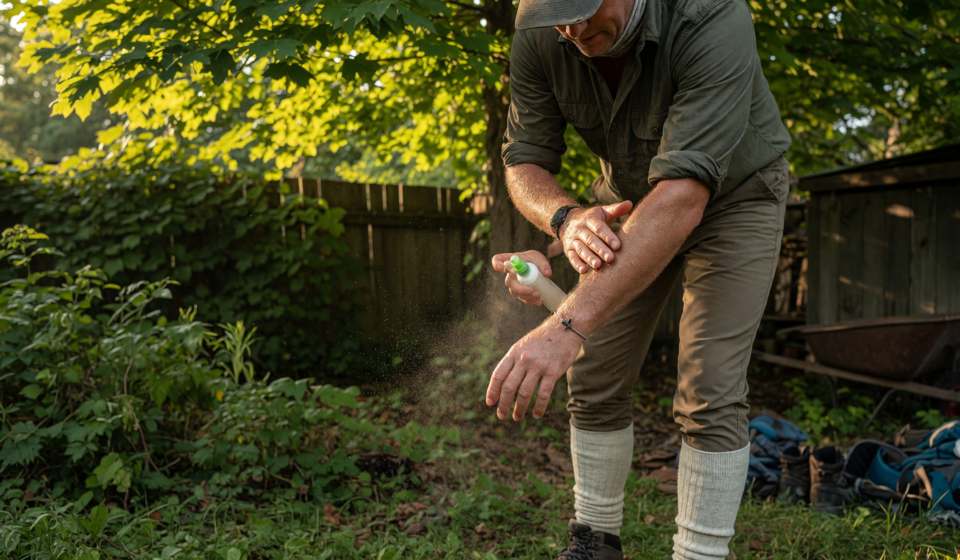
👉 Shop EPA-registered skin repellent (DEET or picaridin) on Amazon (Ad — as an Amazon Associate, we earn from qualifying purchases.)
Permethrin-Treated Clothing and Gear: A Separate Layer
If skin repellent is your first line, permethrin is your second, and it’s the layer most people skip. Permethrin is an insecticide that kills or repels mosquitoes and ticks on contact with treated fabric. The single most important rule, straight from the CDC, is that permethrin is for clothing and gear only. Do not apply permethrin products directly to your skin. It’s designed to bond to fabric, not to be worn on the body like lotion.
Skin vs. fabric. Keep the two layers straight: EPA-registered repellents (like DEET or picaridin) go on exposed skin, while permethrin goes on clothing and gear and is never applied to skin. Used together, they cover the target from two directions.
You have two ways to get the permethrin layer, and both are legitimate:
- Factory-treated apparel: Clothing and gear pre-treated with permethrin at the factory, which typically holds up through a stated number of washes.
- DIY treatment: A 0.5% permethrin spray you apply yourself to boots, shirts, pants, socks, and tents, following the product label exactly.
- Read the label for duration: How long the protection lasts varies by product and by how many times the item is washed, so check the label rather than guessing.
- Let it dry fully: Treated items must dry completely before you wear them; apply in a ventilated space away from where you prep food.
Because ticks tend to climb up from your feet and lower legs, treating socks, footwear, and pant legs is especially high-value. That’s the exact territory a tick crosses before it ever reaches skin, and treated fabric can stop it there.
👉 Shop permethrin clothing spray or factory-treated apparel on Amazon (Ad — as an Amazon Associate, we earn from qualifying purchases.)
Dress to Be a Harder Target
Clothing does quiet, unglamorous work in this system. Simply covering more skin gives ticks fewer places to attach and mosquitoes fewer places to bite, and a few small choices turn ordinary clothes into a real barrier. None of this requires special equipment, just a bit of intention before you head out.
- Cover skin: Long sleeves and long pants reduce exposed targets, especially in tall grass and brush.
- Tuck strategically: Tuck your shirt into your pants and your pant legs into your socks so ticks can’t slip underneath and have to travel over fabric instead.
- Go light-colored: Lighter clothing makes it far easier to spot a dark tick crawling before it finds skin.
- Choose your route: Walk in the center of trails and avoid brushing against tall grass and leaf litter, where ticks wait to hitch a ride.
Pair these habits with the permethrin layer above and you’ve made yourself a genuinely inconvenient host, which is exactly the point. Most bites are prevented not by a single heroic measure but by stacking several small ones.
The Tick Check: Your Last and Best Line
No repellent is perfect, so the after-outdoors inspection is where you catch whatever slipped through. Because ticks often wander before biting and can transmit disease more readily the longer they stay attached, finding and removing them promptly genuinely lowers your risk. Make the check a routine, not an afterthought.
The CDC recommends a specific set of habits once you come indoors:
- Shower soon: Showering within two hours of coming indoors has been shown to reduce the risk of Lyme disease and helps wash off unattached ticks.
- Do a full-body check: Look carefully under the arms, in and around the ears, inside the belly button, behind the knees, around the hairline, between the legs, and around the waist.
- Check gear and pets: Ticks ride indoors on coats, daypacks, and animals, then attach later, so inspect them too.
- Tumble dry clothing: Putting dry clothes in a dryer on high heat for 10 minutes kills ticks; damp clothing needs additional time.
If you do find an attached tick, remove it promptly with fine-tipped tweezers, grasping close to the skin and pulling upward with steady, even pressure. Then clean the area. Keep an eye on how you feel in the days and weeks that follow, and talk to a healthcare provider if you develop a rash, fever, or other symptoms.
👉 Shop fine-tipped tick removal tweezers or tick kit on Amazon (Ad — as an Amazon Associate, we earn from qualifying purchases.)
Around the House: Reduce the Pressure at Home
Your yard is part of the system too. Reducing the habitat these pests love means fewer of them waiting for you every time you step outside, which lightens the load on all your other layers.
- Drain standing water: Mosquitoes breed in still water, so empty buckets, planter saucers, birdbaths, and clogged gutters regularly, ideally about once a week.
- Cut the grass and clear leaf litter: Ticks favor tall grass, brush, and damp leaf debris, so keeping the lawn trimmed and edges tidy makes your yard less hospitable.
- Create a buffer: A border of wood chips or gravel between lawn and woods can help discourage ticks from migrating into the areas you use most.
- Screen and vent: Well-fitted window and door screens keep mosquitoes out of the living space, where you’d otherwise let your guard down.
These steps don’t replace personal protection, but they lower the baseline. Fewer pests around the property means every walk to the mailbox or evening on the patio starts from a safer place.
Building Your Everyday Routine
Put it all together and the system is easy to run. The layers reinforce each other, so you don’t need any single one to be flawless. Think of it as a short checklist you can internalize after a couple of outings.
- Before you go: Apply an EPA-registered repellent to exposed skin and wear permethrin-treated clothing, dressing to cover and tuck.
- While you’re out: Stay on trail centers, avoid brushing tall grass, and reapply skin repellent on the label’s schedule.
- When you come in: Shower within two hours, run a full-body tick check, inspect gear and pets, and tumble dry clothing on high heat.
- At home: Keep standing water drained and the yard trimmed to reduce pressure over the whole season.
Match the intensity to the setting. A quick evening in a mowed backyard doesn’t demand the same rigor as a full day bushwhacking through tick country, but the same building blocks scale up and down cleanly.
The Bottom Line
Reliable protection from ticks and mosquitoes comes from stacking simple, proven layers rather than betting everything on one product. Put an EPA-registered repellent on your skin, put permethrin on your clothing and gear (never the other way around), dress to cover and tuck, and finish every outing with the CDC’s shower-and-check routine. None of these steps is difficult, and none takes long, but together they close the quiet gap between exposure and discovery where bites and disease take hold. Build the habit once, run it all season, and you’ll spend far less time worrying about what came home with you.
Disclaimer: This article is for general educational purposes only and is not medical, safety, or professional advice. Always read and follow the manufacturer’s label and instructions for any repellent or insecticide product, and consult a qualified healthcare provider about tick bites, symptoms, or health concerns.
Sources: U.S. Environmental Protection Agency (EPA), Skin-Applied Repellent Ingredients and Repellent-Treated Clothing; U.S. Centers for Disease Control and Prevention (CDC), About Permethrin-Treated Clothing and Gear, Preventing Tick Bites, and Preventing Mosquito and Tick Bites; National Pesticide Information Center (NPIC).