
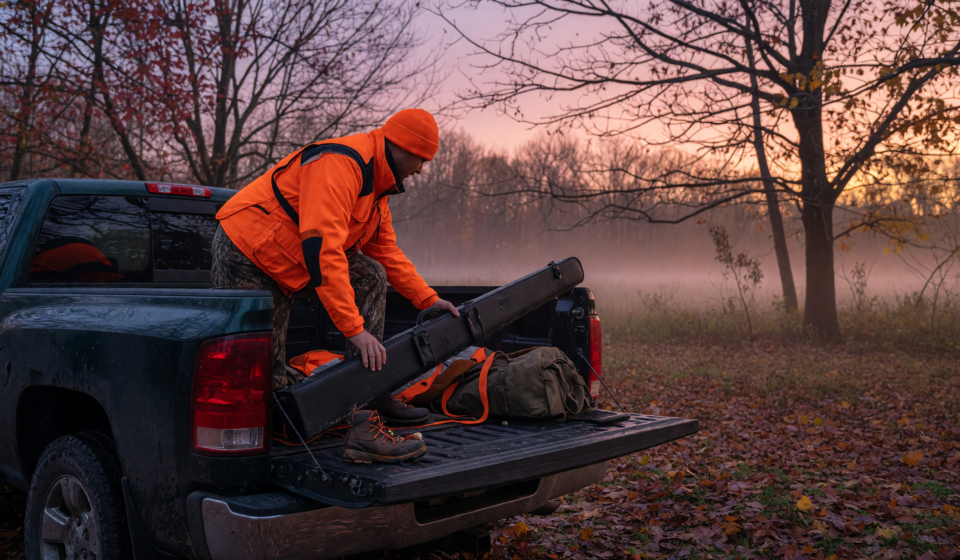
Hunting Trip Travel Safety: Transporting Gear and Blaze Orange Essentials
The truck is loaded before dawn, coffee is going cold in the cupholder, and somewhere in the back is a rifle case, a bow, a climbing harness, and enough orange to light up a foggy ridge. That first morning of the season is a genuine thrill, but it is also the moment when small oversights turn into big problems, and smart hunting trip safety starts long before you reach the treeline. Whether you are driving three counties over or flying across the country to chase elk, how you pack, declare, and dress determines whether your trip is remembered for the hunt or for the hassle.
This guide covers the travel side of hunting that rarely makes the highlight reel: how to transport firearms and ammunition legally, how to move a bow and other gear without damage, how to meet your state’s blaze orange requirements, and how to think about fall protection, licensing, and destination laws before you leave home. The rules come from real agencies with real consequences, so we will explain the why behind each one in plain English, point you to the standards that govern them, and flag the gear that keeps you compliant and visible in the field.
Flying With Firearms: The TSA Rules That Actually Matter
If your hunt involves an airplane, the Transportation Security Administration (TSA) sets the ground rules, and they are not suggestions. Firearms are never allowed in carry-on baggage. They must travel in checked baggage only, unloaded, and locked inside a hard-sided container. The single most important detail people miss is the key: TSA guidance is clear that you, the passenger, should be the only one who retains the key or combination to that locked case. If a screener needs to inspect it, they contact you to open it rather than keeping a copy.
- Unloaded and hard-sided: The firearm must be completely unloaded and secured in a hard-sided case that cannot be pried open at a corner.
- Declare at the counter: You must declare each firearm to the airline at the ticket counter during check-in, not at the gate and not at security.
- You keep the key: Only the traveler should retain the means to unlock the case, so no one else can access the firearm in transit.
- Ammunition, packed right: Ammunition is prohibited in carry-on and must be securely packed in checked bags, in the manufacturer’s box or a fiber, wood, or metal container designed to carry small amounts.
A subtle point worth internalizing: TSA considers a firearm “loaded” whenever both the firearm and its ammunition are accessible to the passenger, so the goal is separation and security, not just an empty chamber. Small arms ammunition, generally up to .75 caliber, may be packed in the same locked case as the firearm as long as it is boxed. Because individual airlines layer their own limits on top of federal rules, especially on ammunition weight, call your carrier before you pack.
👉 Shop TSA-compliant lockable hard-sided rifle/pistol case on Amazon (Ad — as an Amazon Associate, we earn from qualifying purchases.)
Packing Bows, Optics, and Gear So Nothing Arrives Broken
Archery tackle is not regulated the way firearms are, but a compound or crossbow represents a serious investment and a finely tuned tool. A bad baggage handler or a shifting pickup bed can knock your sights out of alignment or crack a limb, and a bow that is off by a hair at ten yards is off by a lot at forty. A rigid, foam-lined case protects the cams, string, and sight housing from the impacts that soft cases simply pass through.
- Cushion the optics: Rifle scopes and binoculars survive travel best in padded, crush-resistant compartments; note that TSA does allow scopes in either carry-on or checked bags.
- Immobilize everything: Empty space lets gear slide and slam, so fill voids with foam or clothing to keep each item locked in place.
- Protect the broadheads: Fixed and mechanical broadheads should ride in a dedicated case so nothing gets nicked, and no one gets cut reaching into a bag.
- Guard against moisture: A few desiccant packs fight the condensation that fogs optics and rusts steel during long transits and temperature swings.
Re-check your zero once you arrive. Even a perfectly packed rifle or bow deserves a few confirmation shots at the range before opening morning, both for accuracy and for the ethical obligation to make clean, humane shots.
👉 Shop hard bow case and padded optics case on Amazon (Ad — as an Amazon Associate, we earn from qualifying purchases.)
Blaze Orange: What the Law Requires and Why It Works
Hunter orange, often called blaze orange, is the single cheapest piece of safety equipment you can wear, and in most states it is not optional during firearm seasons. The color exists because the human eye picks up daylight fluorescent orange against natural backdrops far better than it registers browns, greens, or reds, and critically, big game animals like deer do not perceive it the way we do. It makes you visible to other hunters without making you visible to your quarry.
The specifics are set state by state through the relevant fish and wildlife or natural resources agency, so there is no single national number. That said, common thresholds cluster around a required minimum of solid orange worn above the waist and visible from all directions. Many states specify a figure in the range of roughly 400 to 500 square inches, and most want it on your head, chest, and back rather than tucked out of sight.
- Solid, not camo: Most regulations require solid daylight fluorescent orange; camouflage patterns that merely include orange usually do not count.
- Visible from all sides: A vest plus a cap is the classic combination because it satisfies the “seen from every direction” intent behind the rules.
- Blaze pink in some states: A growing number of states now accept blaze pink as a legal alternative, so check whether your destination is one of them.
- Method and species matter: Archery-only seasons and pursuits like waterfowl or turkey often carry different or reduced requirements.
Verify before you travel. Blaze orange rules are written and enforced by each state’s wildlife agency and can differ sharply across a state line. The amount, placement, and even acceptable colors that are legal at home may not satisfy the regulations where you are hunting, so confirm the current requirements with the destination agency before opening day.
👉 Shop blaze orange vest and cap set on Amazon (Ad — as an Amazon Associate, we earn from qualifying purchases.)
Tree Stands and Fall Protection on the Road
Falls from elevated stands are consistently cited by state wildlife agencies as a leading cause of serious hunting injuries, often outranking firearm incidents. That risk does not shrink because you are hunting unfamiliar ground; if anything, a new property with unknown trees and untested public-land stands raises it. A full-body harness used as part of a fall-arrest system is the answer, and it belongs in your travel bag every bit as much as your license.
- Look for TMA certification: Harnesses built to the Treestand Manufacturers Association standard are tested for fall-arrest performance rather than just marketed as safe.
- Stay connected the whole time: Most falls happen while climbing or transitioning, so a lifeline that keeps you tethered from the ground to the stand and back closes that gap.
- Carry a recovery plan: A suspension-relief strap and a way to signal or call for help matter if you fall and end up hanging while you wait for rescue.
- Inspect before you climb: Never trust a stand you did not hang; check straps, welds, and cables on any unfamiliar setup before you trust it with your weight.
👉 Shop TMA-certified full-body safety harness / fall-arrest system on Amazon (Ad — as an Amazon Associate, we earn from qualifying purchases.)
Licenses, Tags, and Crossing State Lines
The paperwork side of an out-of-state hunt is where trips quietly go sideways. Nonresident licenses and tags are handled entirely by each state’s wildlife agency, and many species require applying well ahead of the season or entering a draw months in advance. Show up without the right tag for the right unit and season, and a dream hunt becomes a citation.
- Match the tag to the unit: Licenses are often tied to specific game management units, weapons, and dates, so read the fine print, not just the species.
- Know the transport rules: Many states dictate how harvested game and even carcass parts may be transported across lines, partly to slow the spread of chronic wasting disease.
- Understand firearm reciprocity: Concealed-carry and transport laws differ by state, so confirm how your firearms may legally be carried and stored where you are headed.
- Keep proof accessible: Carry your hunter education card and licenses in a waterproof pouch, since a warden can ask to see them anywhere in the field.
Road-Trip Hunting: Vehicle Transport Done Right
Most hunts still happen at the end of a drive, and driving with firearms carries its own patchwork of state laws. The safe default that keeps you legal across most jurisdictions is to transport firearms unloaded and cased, with ammunition stored separately, ideally in a locked area away from the passenger compartment. This mirrors the spirit of the federal rules for interstate transport and removes any question about a gun being “accessible.”
- Unloaded and cased: Keep long guns and handguns in cases, not loose behind the seat where they can shift, get damaged, or raise legal questions.
- Separate the ammunition: Storing ammo apart from the firearm reduces both the legal and the practical risk during a traffic stop or accident.
- Secure the load: Tie down stands, coolers, and gear so nothing becomes a projectile in a sudden stop.
- Pack a real first-aid kit: Remote hunting ground is a long way from an emergency room, so carry supplies you actually know how to use.
A Pre-Trip Checklist You Can Trust
The hunters who travel smoothly are the ones who run the same routine every time. A written checklist beats memory at 4 a.m., and it turns a scramble into a calm departure. Build yours around the essentials and adjust for the hunt, the weather, and the distance.
- Documents: Licenses, tags, hunter education card, and a photo ID, all confirmed valid for your dates and unit.
- Firearm compliance: Hard case, lock, and a plan to declare at the airline counter or transport legally by road.
- Visibility: Enough blaze orange to meet the destination state’s minimum, verified against current regulations.
- Fall protection: A certified harness and lifeline packed alongside your stand or climbing sticks.
- Communication: A charged phone, a backup power source, and a shared plan telling someone where you will be and when you will check in.
The Bottom Line
A great hunt is built on preparation you never see in the photos: the locked case declared without drama, the orange vest that made you unmistakable on a crowded ridge, the harness clipped in before your boots left the ground, and the tag that was already in your pocket. Follow the TSA rules to the letter, meet your destination state’s blaze orange and licensing requirements, and treat fall protection as non-negotiable, and the travel becomes what it should be, the easy part. Do that groundwork, and you free yourself to focus on the reason you set the alarm in the first place. Hunt safe, travel smart, and let the woods be the only thing on your mind when the sun comes up.
Disclaimer: This article is provided for general educational purposes only and does not constitute legal advice. Firearm transport, hunting, blaze orange, and licensing laws vary by state and change over time, and airline policies differ by carrier. Always verify current requirements with the TSA, your airline, and the wildlife agency for every state you travel through or hunt in before your trip.
Sources: Transportation Security Administration (TSA), “Transporting Firearms and Ammunition” and firearms/ammunition fact sheet; state fish, wildlife, and natural resources agency blaze orange and hunter education regulations; Treestand Manufacturers Association (TMA) fall-arrest harness standards.


