Hearing Protection at Work: NRR Ratings and OSHA Limits Explained
Hearing loss doesn’t announce itself. There’s no sharp pain, no visible wound, no bad day you can point to afterward. It arrives one quiet decibel at a time, across months and years on a loud floor, until one afternoon you realize you’ve been asking people to repeat themselves and the television keeps creeping louder. By then the damage is done — and unlike a cut or a bruise, noise-induced hearing loss never heals. The tiny hair cells in your inner ear that translate sound into signals your brain understands do not grow back.
That’s the bad news. The good news is that occupational hearing loss is almost entirely preventable, and the tools that prevent it cost a few dollars. The catch is that hearing protection only works when it fits, when you wear it every time, and when it’s actually rated for the noise you’re facing. This guide walks through how workplace noise is measured, what OSHA requires, how to decode the Noise Reduction Rating (NRR) printed on every package, and how to choose between earplugs, earmuffs, and the newer electronic options.
How loud is too loud?
Sound intensity is measured in decibels (dB), but the decibel scale is not linear — it’s logarithmic. Every increase of 3 dB roughly doubles the sound energy hitting your ear. That means 93 dB is twice as intense as 90 dB, and 100 dB is more than three times as intense as 91 dB, even though the numbers look close together.
For a sense of scale: a normal conversation runs about 60 dBA. A gas lawnmower or a busy city street sits near 90 dBA. A chainsaw, an angle grinder, or a nightclub reaches 100–110 dBA. A jackhammer or a nearby jet engine can top 120–130 dBA, where damage can begin almost immediately. (The “A” in dBA means the meter is weighted to match how the human ear actually perceives loudness.)
The two factors that determine whether noise hurts you are how loud it is and how long you’re exposed. A single loud bang and a full shift of moderate droning can both cause harm through very different paths.
What OSHA actually requires
The Occupational Safety and Health Administration sets the legal baseline for workplace noise in the United States under standard 29 CFR 1910.95. Two numbers matter most:
- The Permissible Exposure Limit (PEL) is 90 dBA averaged over an 8-hour shift. Above this, employers must reduce exposure through engineering or administrative controls, and hearing protection is required.
- The Action Level is 85 dBA averaged over 8 hours. At or above this, the employer must implement a full Hearing Conservation Program — noise monitoring, free annual hearing tests (audiograms), training, and hearing protectors offered at no cost to the worker.
OSHA uses a “5-dB exchange rate,” which means the allowed exposure time halves for every 5 dBA increase. So 90 dBA is permitted for 8 hours, 95 dBA for only 4 hours, 100 dBA for 2 hours, and 105 dBA for just 1 hour. It’s worth knowing that many hearing experts — including NIOSH, the research agency — consider OSHA’s limits too permissive. NIOSH recommends a Recommended Exposure Limit of 85 dBA and a more protective 3-dB exchange rate. If you’re building a program from scratch, the NIOSH numbers are the safer target.
Decoding the NRR
Every hearing protector sold in the U.S. carries a Noise Reduction Rating (NRR) on the packaging, a single number in decibels required by the EPA. A pair of foam earplugs might be rated NRR 32; a set of earmuffs might read NRR 27. Higher looks better — but the NRR is measured in a laboratory under ideal conditions, with a perfect fit that almost nobody achieves on a real work floor.
Because of that gap, OSHA recommends derating the NRR before you rely on it. The simplest official method: subtract 7 from the NRR, then divide by two. The result is a realistic estimate of the protection you’ll get in the field.
Worked example. You’re running a grinder at 100 dBA and wearing foam plugs rated NRR 32. Real-world protection ≈ (32 − 7) ÷ 2 = 12.5 dB. Your effective exposure is about 100 − 12.5 = 87.5 dBA — still above NIOSH’s 85 dBA target. The plugs help enormously, but on a long shift you’d want a better fit or to combine protectors.
When you double up — wearing foam plugs under earmuffs — you do not add the two NRRs together. The accepted rule of thumb is to take the higher of the two NRRs and add about 5 dB. Dual protection is the right call above roughly 105 dBA, or anywhere impact noise is severe.
Earplugs vs. earmuffs vs. electronic
Foam and pre-molded earplugs
Disposable foam plugs are cheap, compact, and offer the highest lab NRRs — but only if they’re rolled down thin and inserted deep enough to sit well inside the ear canal, not just perched at the opening. A plug you can see poking out is a plug that’s barely working. Reusable pre-molded (flanged) plugs are easier to insert consistently and better suited to workers who move in and out of noisy areas all day. Corded versions keep them from disappearing.
👉 Shop foam and reusable earplugs on Amazon (Ad — as an Amazon Associate, we earn from qualifying purchases.)
Earmuffs
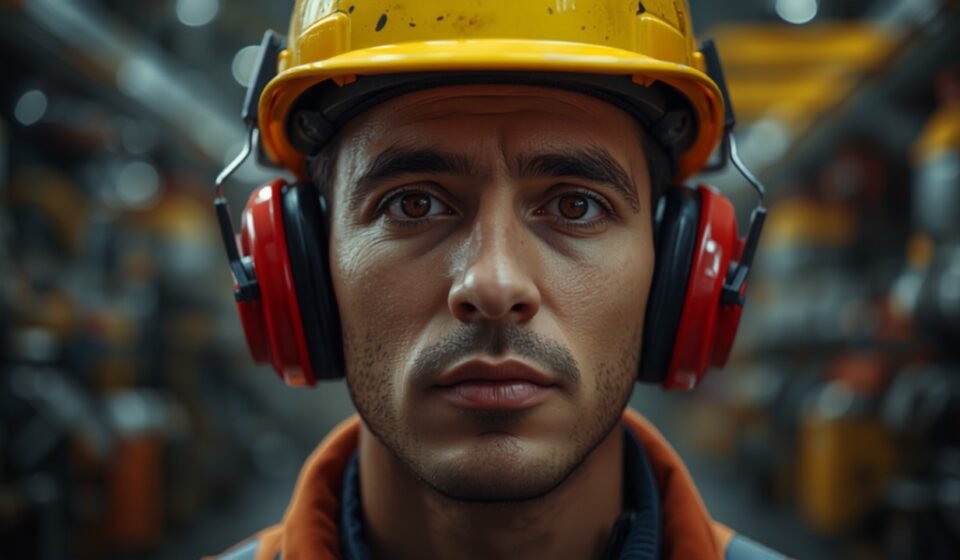
Over-the-ear muffs are the go-to when a job involves frequent on-and-off protection, when workers have ear infections or can’t tolerate plugs, or when a supervisor needs to see compliance at a glance. They’re consistent because there’s no insertion technique to get wrong. The trade-offs: they’re bulkier, hotter in summer heat, and their seal is compromised by safety-glasses temple arms, long hair, or hard-hat straps breaking the cushion contact. Cap-mounted muffs that clip to a hard hat solve the compatibility problem on construction sites.
👉 Shop over-the-ear safety earmuffs on Amazon (Ad — as an Amazon Associate, we earn from qualifying purchases.)
Electronic and level-dependent protection
Electronic earmuffs use microphones to pass through quiet sounds — a coworker’s voice, a backup alarm, a warning shout — while instantly clamping down on loud impulse noise. They’re popular with shooters, on ranges, and anywhere situational awareness matters as much as protection. Expect to pay considerably more, and remember they still need batteries. For most industrial settings, well-fitted passive protection is enough; electronic muffs earn their price where communication and sudden loud events coexist.
Fit is everything
The most expensive hearing protector in the world does nothing sitting loose in your ear. A few habits close the gap between the number on the box and the protection on your head:
- Foam plugs: roll them into a thin, crease-free cylinder, reach over your head with the opposite hand to pull your ear up and back, then insert and hold for 20–30 seconds while the foam expands.
- Check the seal: cup your hands over your ears. If the noise drops noticeably when you do, your plugs aren’t sealing — reinsert them.
- Muffs: make sure nothing breaks the cushion seal. Push safety-glasses arms under the cushion or switch to thin-temple glasses.
- Replace worn gear: hardened foam plugs and cracked, stiff muff cushions leak. Foam plugs are single-use for a reason.
Larger employers increasingly use fit-testing systems that measure each worker’s Personal Attenuation Rating — the real, individual protection they’re getting. If your program offers it, take advantage; the results are often humbling.
Warning signs you’re overexposed
Your ears will tell you when a noise environment is dangerous, if you know the signals. Take any of these seriously:
- Ringing, buzzing, or humming in your ears after a shift (tinnitus) — an early red flag.
- Temporary muffled hearing that returns to normal overnight. It won’t stay temporary forever.
- Having to raise your voice or stand within arm’s length to be heard — a rough sign the area is at or above 85 dBA.
- Trouble following conversation in crowded rooms, or family complaints that the TV is too loud.
A quick reality check: if you have to shout to talk to someone about three feet away, the noise around you is almost certainly loud enough to require protection.
Choosing the right protection: a quick framework
- Measure or estimate the noise. A smartphone sound-level app gets you in the ballpark; a calibrated dosimeter is what a real program uses.
- Derate the NRR using (NRR − 7) ÷ 2 and confirm the result drops your exposure below 85 dBA.
- Match the style to the task. All-day steady noise favors comfortable reusable plugs; in-and-out work favors muffs; extreme noise above ~105 dBA calls for doubling up.
- Prioritize comfort. The protector a worker actually keeps on beats a higher-rated one that lives in a pocket.
The bottom line
Noise-induced hearing loss is permanent, cumulative, and completely preventable. OSHA draws the legal line at 90 dBA over 8 hours and requires a conservation program at 85 dBA — but the smarter target is NIOSH’s 85 dBA limit with realistic, derated expectations for whatever protector you choose. Read the NRR, cut it down to its real-world value, get the fit right, and wear it every single time. Your future self — the one who can still follow a conversation across a noisy dinner table — will thank you.
Disclaimer: This article is for general educational purposes and is not a substitute for a formal workplace noise assessment or professional medical advice. Employers should consult 29 CFR 1910.95 and a qualified safety professional to build a compliant hearing conservation program.
Sources: OSHA Occupational Noise Exposure standard (29 CFR 1910.95); NIOSH Criteria for a Recommended Standard: Occupational Noise Exposure; U.S. EPA Noise Reduction Rating labeling requirements (40 CFR Part 211).