Safety Glasses and ANSI Z87.1: The Complete Buyer’s Guide
Thousands of American workers suffer an eye injury on the job every single day, and study after study reaches the same uncomfortable conclusion: the overwhelming majority were either wearing no eye protection or the wrong kind for the task. Safety glasses are cheap, widely available, and remarkably effective — yet the wall of options at the supply store, stamped with cryptic codes like Z87+, D3, and U6, leaves most buyers guessing. This guide translates those codes and shows you how to choose eyewear that protects and stays on your face.
The One Standard That Matters: ANSI Z87.1
In the United States, eye and face protection is measured against a single consensus standard: ANSI/ISEA Z87.1, published by the International Safety Equipment Association. OSHA’s eye-protection rule (29 CFR 1910.133) requires employers to provide eye protection and points to Z87.1 as the benchmark. If a pair of glasses does not carry a Z87 marking, it is fashion eyewear — not safety eyewear — no matter how tough it looks.
Z87.1 tests eyewear against impact, and, where marked, against splash, dust, and optical radiation. The key thing to understand is that the markings printed on the frame and lens are not decoration — they are a compact spec sheet telling you exactly what the eyewear is rated to stop.
How to Read the Markings
Look at the frame (and often the lens). You will find the manufacturer’s mark followed by a string of codes. Here is what they mean:
- Z87 — meets the basic impact requirement.
- Z87+ — meets the high-impact requirement (this is the one you usually want). To earn the plus, the eyewear must pass both a high-mass test (a pointed weight dropped from height) and a high-velocity test (a quarter-inch steel ball fired at roughly 150 feet per second).
- D3 — splash and droplet protection (chemicals, liquids).
- D4 — dust protection.
- D5 — fine dust protection.
- U + number — UV filter (scale roughly U2–U6).
- R + number — infrared (IR) filter.
- L + number — visible-light filter (tint density).
- W + shade — welding filter shade.
- V — photochromic (auto-darkening) lens; S — special tint; H — designed for smaller head sizes.
For most impact hazards — grinding, machining, carpentry, yard work — the marking to look for is simply Z87+. Add a D3 for anything involving chemical splash, and a UV rating for outdoor work.
👉 Shop ANSI Z87+ safety glasses on Amazon (Ad — as an Amazon Associate, we earn from qualifying purchases.)A pair of Z87+ safety glasses is the single cheapest, highest-return piece of protective gear most people can own — worth keeping in the garage, the shed, and the truck.
Glasses, Goggles, or Face Shield?
The form factor should match the hazard, not personal preference:
- Safety glasses with side shields: flying particles and general impact. The everyday workhorse.
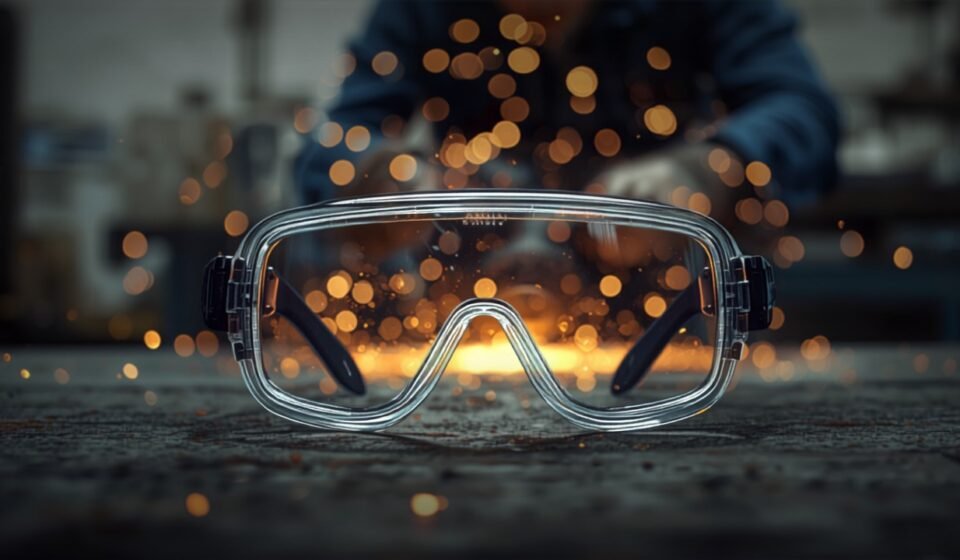
- Safety goggles: a sealed barrier for chemical splash, fine dust, or high-particle environments. A foam or vented gasket keeps liquids and dust out.
- Face shields: for grinding, chipping, or heavy splash — but a shield is secondary protection. It is worn over safety glasses or goggles, never instead of them, because it does not seal around the eyes.
- Over-the-glasses (OTG) styles: designed to fit over prescription eyeglasses when dedicated safety Rx isn’t available.
Lenses and Coatings
Nearly all modern safety lenses are made of polycarbonate — a material that is inherently impact-resistant and blocks essentially all UV, which is why so much safety eyewear carries UV protection by default. Trivex is a premium alternative with similar impact resistance and slightly better optical clarity.
Coatings make the difference between eyewear that gets worn and eyewear that gets pushed up onto a forehead:
- Anti-fog — arguably the most important coating for real-world compliance. Fogged lenses get removed, and removed lenses protect nothing.
- Anti-scratch — extends usable life; scratched lenses that obscure vision are a hazard in themselves.
- Tints and mirrors — gray for bright sun, amber for low light and contrast, clear for indoors. Choose the tint for the lighting, and never wear dark lenses in dim conditions.
Fit Is Protection
The best-rated glasses in the world protect nothing if they slide down a nose or fog on the first humid afternoon. Prioritize an adjustable, comfortable fit: wrap-around styles close the gap at the temples, adjustable nose pads and temple arms tune the fit, and foam-gasketed frames block dust and wind for outdoor and grinding work. When you outfit a crew, offer more than one style and size — the pair someone finds comfortable is the pair that stays on.
Prescription Safety Eyewear
If you wear glasses, ordinary prescription lenses are not safety-rated — they can shatter on impact. OSHA requires that where eye protection is needed, workers who wear corrective lenses either use eye protection that incorporates the prescription or wear protection that fits over their glasses without disturbing the fit. In practice that means one of three routes: prescription safety glasses (Z87-rated frames and Rx lenses), OTG safety glasses worn over your everyday pair, or lens inserts behind a goggle. For anyone doing hazardous work daily, dedicated Z87 prescription eyewear is the comfortable, reliable choice.
A Word on Welding and Bright Light
Welding, cutting, and brazing produce intense UV and infrared radiation that ordinary tinted glasses do not stop. These tasks require filters with the correct shade number matched to the process and amperage — too light a shade allows an invisible, cumulative burn to the eyes known as “arc eye.” Never substitute sunglasses for a proper welding filter, and remember that helpers and bystanders need protection too.
Care and Replacement
Rinse lenses before wiping to avoid grinding grit across them, clean with a microfiber cloth and lens-safe cleaner, and store them in a case or pouch rather than face-down on a bench. Replace lenses once scratches begin to obscure vision, and retire any eyewear that has taken a significant impact — a cracked or crazed lens can fail at the worst moment.
Common Mistakes
- Buying “Z87” when you need “Z87+.” For most impact work, insist on the high-impact plus rating.
- Using a face shield alone. It is secondary protection — always pair it with glasses or goggles.
- Ignoring fog. Skip anti-fog and you have bought glasses that live on a forehead.
- Relying on regular eyeglasses. Everyday prescription lenses are not impact-rated.
Frequently Asked Questions
What does Z87+ mean?
It certifies that the eyewear meets the ANSI/ISEA Z87.1 high-impact requirement, passing both a high-mass and a high-velocity impact test. Plain “Z87” indicates basic impact protection only.
Do safety glasses expire?
There is no fixed date, but replace them once lenses are scratched enough to impair vision, coatings wear off, or after any significant impact. Damaged eyewear is a hazard, not protection.
Can I wear safety glasses over my prescription glasses?
Yes — over-the-glasses (OTG) safety glasses are made for exactly that. For daily hazardous work, though, dedicated Z87 prescription safety eyewear is more comfortable and reliable.
The Bottom Line
Protecting your eyes comes down to three decisions: choose eyewear marked Z87+ (plus any splash, dust, or UV rating your task demands), match the form factor — glasses, goggles, or shield — to the hazard, and pick a comfortable, anti-fog pair you will actually keep on. Eyes do not heal like skin. A few dollars of the right eyewear, worn consistently, is one of the best trades in all of safety.
This article is general safety information, not professional advice. Standards are periodically revised and requirements vary by task and jurisdiction. Always follow the manufacturer’s instructions and your workplace’s hazard assessment. Sources: U.S. Occupational Safety and Health Administration (OSHA, 29 CFR 1910.133); International Safety Equipment Association (ANSI/ISEA Z87.1).