Pedestrian Safety at Dusk: Reflective Wear for Summer Evening Walks
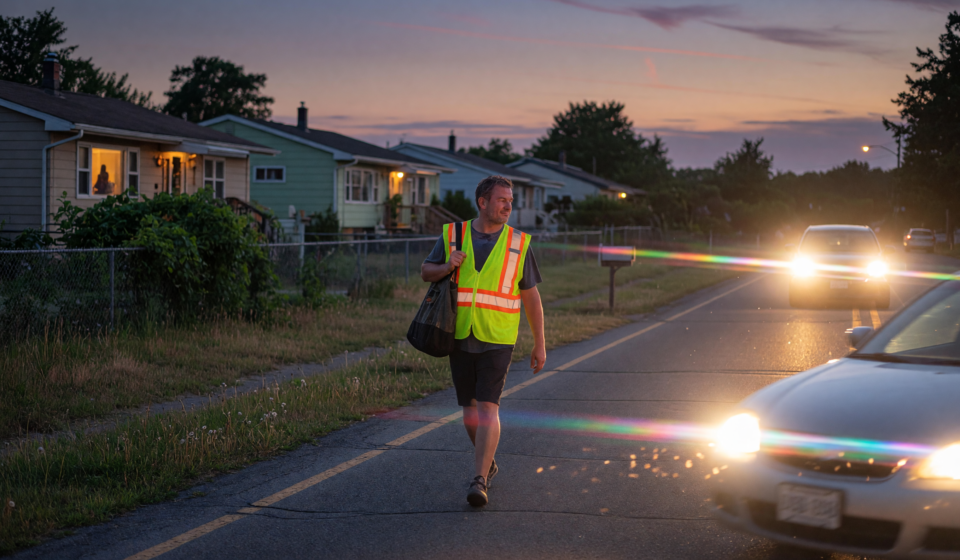
There is a particular hour on a warm summer evening when the light turns golden, then gray, and the neighborhood empties onto the sidewalks. Dog walkers, joggers, families pushing strollers, teenagers heading to a friend’s house. It feels like the safest time of day to be out on foot. The heat has broken, the streets are calm, and everyone is relaxed. That relaxed feeling is exactly the problem, because the fading light that makes the evening so pleasant is also quietly stripping away a driver’s ability to see you. Good pedestrian evening safety starts with understanding that dusk is not a gentle in-between. It is one of the trickiest visibility windows of the entire day.
This guide explains why summer evenings put walkers at unexpected risk and, more importantly, what you can do about it. We will cover the science of how the human eye struggles at twilight, what US safety agencies actually report about walking after dark, and how reflective and retroreflective wear works to buy a driver those critical extra seconds. We will translate the ANSI/ISEA 107 high-visibility apparel standard into plain English, walk through how to choose gear for casual evening strolls, and explain why where you place reflective material matters just as much as how much you wear. The goal is simple: help you enjoy those long summer walks while making sure every driver on the road sees you coming.
Why Summer Dusk Fools Everyone
Dusk is deceptive because our brains tell us it is still daytime while our eyes are already losing the fight. As natural light fades, the eye shifts from sharp, color-rich daytime vision to a grainier, lower-contrast mode built for low light. Depth perception softens, motion is harder to judge, and objects without their own light source seem to melt into the background. A driver rolling through a familiar street at 7:30 on a July evening genuinely feels like they can see fine, right up until a walker in a gray t-shirt steps off a curb.
Summer adds its own complications. Longer daylight means more people are out walking later into the evening, right through the transition hours. Low sun angles near the horizon create harsh glare that can wash out a windshield entirely. And the warm-weather wardrobe tends toward light cottons and muted athletic wear rather than anything designed to be seen. The result is a lot of pedestrians on the road at precisely the moment drivers are least equipped to spot them.
What the Data Says About Walking After Dark
The pattern in the national numbers is hard to ignore. According to the National Highway Traffic Safety Administration (NHTSA), the large majority of pedestrian fatalities occur in dark conditions rather than in daylight, with dawn and dusk making up smaller shares. In other words, the risk to people on foot climbs sharply once the sun is down and stays elevated through the night. The Federal Highway Administration (FHWA) has made nighttime visibility a national safety priority through its Everyday Counts initiative, precisely because low-light conditions account for such a disproportionate share of the harm.
What these agencies consistently point to is a mismatch: pedestrians assume that if they can see the car, the driver can see them. But a walker sees bright, obvious headlights, while the driver is scanning a dim scene for a low-contrast human shape. That asymmetry is the heart of the problem, and it is the single strongest argument for wearing something that actively returns light to a driver’s eyes.
The visibility gap. You can almost always see an approaching car before its driver can see you. Reflective wear does not make you brighter to yourself. It closes the gap by making you brighter to the person behind the wheel, which is the only viewpoint that actually prevents a crash.
Reflective Versus Retroreflective: How the Gear Actually Works
People use the word “reflective” for everything, but there is an important distinction. A bright or fluorescent fabric relies on ambient light. Fluorescent colors like safety yellow-green and orange are terrific during daylight and at dusk because they convert some invisible ultraviolet light into extra visible glow, which is why they look almost electric in the last hour before sunset. But once true darkness falls, fluorescence has nothing to work with and those colors go flat.
Retroreflective material is the nighttime workhorse. Instead of scattering light in all directions the way ordinary surfaces do, retroreflective tape and trim send light straight back toward wherever it came from. When a car’s headlights hit it, the beam bounces back to the driver’s eyes and the material appears to light up. The catch, and it is a big one, is that retroreflective material only works when there is a light source pointed at it. It does nothing on its own. That is exactly why the best evening-walk strategy pairs both: fluorescent color for the twilight window and retroreflective trim for full dark.
- Fluorescent color: Boosts daytime and dusk conspicuity by amplifying available light; useless in true darkness.
- Retroreflective material: Returns headlight beams to the driver at night; useless without a light source aimed at it.
- The winning combination: Wearing both covers the full range from golden hour to full dark, which is the whole span of a summer evening walk.
👉 Shop reflective vest or sash with fluorescent base color on Amazon (Ad — as an Amazon Associate, we earn from qualifying purchases.)
Making Sense of the ANSI/ISEA 107 Label
If you shop for reflective gear you will run into the phrase ANSI/ISEA 107. This is the American national standard for high-visibility safety apparel, developed by the International Safety Equipment Association and approved by the American National Standards Institute. It was written mainly for workers, roadway crews, flaggers, first responders, warehouse staff, so it is not a law that applies to you on an evening stroll. But the label is still a genuinely useful shorthand for how much visibility a garment is engineered to deliver, and understanding it helps you buy smart.
The standard sorts garments by type and by performance class. Types describe the intended environment, and classes describe how much high-visibility background and retroreflective material a garment carries. Higher classes mean more coverage and, generally, more conspicuity.
- Type O (off-road): Designed for controlled, lower-speed settings like warehouses and parking areas; carries Performance Class 1.
- Type R (roadway): Meant for areas with traffic exposure; offered in Class 2 and Class 3, with Class 3 providing the most material and the highest conspicuity.
- Type P (public safety): Built for first responders in Class 2 and Class 3, often cut shorter for access to equipment.
- What it means for you: A garment meeting a recognized class has been tested for a real amount of retroreflective and background material, so the label is a reliable signal even for non-work use.
You do not need a full Class 3 jacket to walk the dog. But leaning toward a garment built to a known class, rather than a novelty item with a token strip of shiny trim, means the reflective performance is more than decorative.
Choosing Reflective Wear for Real Evening Walks
The best reflective gear is the gear you will actually wear on a muggy August night, so comfort and convenience matter enormously. A stiff, hot safety jacket that lives in the closet protects no one. For most casual walkers, a lightweight reflective vest, a breathable sash, or a running belt with retroreflective trim hits the sweet spot between visibility and comfort. If you already own athletic wear with reflective piping, treat it as a helpful bonus rather than a complete solution, since small accents alone are rarely enough.
Look for a fluorescent base color for the dusk window, generous bands of retroreflective material that wrap the torso so you are visible from multiple angles, and a fit that layers easily over a t-shirt. Breathability and adjustable sizing make summer wear far more likely to stay on. And do not overlook the people and pets around you: reflective leashes, collars, and kids’ gear extend the same protection to the most unpredictable members of your walking group.
👉 Shop lightweight reflective running belt or breathable summer safety sash on Amazon (Ad — as an Amazon Associate, we earn from qualifying purchases.)
Placement Matters More Than Quantity
Here is a detail most people miss: a driver’s brain recognizes a human faster when reflective material moves in a human way. Researchers call this biomotion. Reflective bands placed on the ankles, wrists, and knees, the parts that swing and stride, read unmistakably as a walking person, far more than a single static patch on the back. A stationary reflective square could be a sign or a mailbox. Moving points of light arranged like a walking gait are instantly, obviously a person.
That is why ankle bands and wrist bands punch above their weight, and why they pair so well with a vest or sash on the torso. You get both a large, bright mass and the tell-tale rhythm of human movement. It is also worth thinking about direction: material that wraps around your body keeps you visible whether a car is approaching from ahead, behind, or turning across your path at an intersection.
- Ankles and wrists: Reflective bands here trigger biomotion recognition, telling drivers “person walking” at a glance.
- Torso wrap: A vest or sash with 360-degree trim keeps you visible from every approach angle, including turning traffic.
- Feet and shoes: Reflective accents low to the ground catch headlight beams directly and move with every step.
👉 Shop reflective ankle and wrist bands for biomotion visibility on Amazon (Ad — as an Amazon Associate, we earn from qualifying purchases.)
Building a Pedestrian Evening Safety Routine
Gear is the foundation, but strong pedestrian evening safety is a set of habits working together. Reflective wear buys you seconds of driver reaction time; smart walking behavior makes sure those seconds count. NHTSA’s own guidance for people on foot stresses staying visible and predictable, and those small choices compound with the right apparel.
- Add active light: Retroreflective material needs headlights to work, so carry a small white front light and consider a blinking red rear light for the darkest stretches.
- Walk facing traffic: Where there is no sidewalk, facing oncoming vehicles lets you see and react to drivers, and them to you.
- Own the crossings: Use crosswalks and intersections, make eye contact with drivers before stepping out, and never assume a car will stop.
- Cut the distractions: Keep the volume low and your eyes up during the transition hours, when driver visibility is at its worst.
- Plan the route: Favor lit streets and sidewalks over dark shoulders, especially as summer evenings stretch later.
The Bottom Line
Summer evening walks are one of the season’s real pleasures, and there is no reason to give them up. But the same softening light that makes them feel so peaceful is the light that hides you from drivers, and the national data leaves little doubt about how much risk shifts once the sun goes down. The fix is refreshingly simple and inexpensive. Wear fluorescent color for the golden hour, add retroreflective material for full dark, put some of that material on your moving ankles and wrists so drivers instantly read “person,” and carry a small light so the retroreflection has something to bounce back. Do that, and you turn yourself from a low-contrast shape a driver might catch too late into someone they see from a block away. Enjoy the long evenings, and make sure every driver on the road sees you enjoying them.
Disclaimer: This article is provided for general educational purposes only and does not constitute safety, legal, or professional advice. High-visibility apparel reduces but does not eliminate risk, and no garment guarantees that a driver will see you. Always follow local traffic laws and use your own judgment when walking near roadways. Verify that any apparel meets the standards and certifications relevant to your intended use.
Sources: National Highway Traffic Safety Administration (NHTSA), Traffic Safety Facts: Pedestrians and Countermeasures That Work (pedestrian fatalities by light condition; conspicuity guidance); Federal Highway Administration (FHWA), Everyday Counts Nighttime Visibility for Safety initiative; ANSI/ISEA 107-2020, American National Standard for High-Visibility Safety Apparel (International Safety Equipment Association / American National Standards Institute), for garment types and performance classes.