
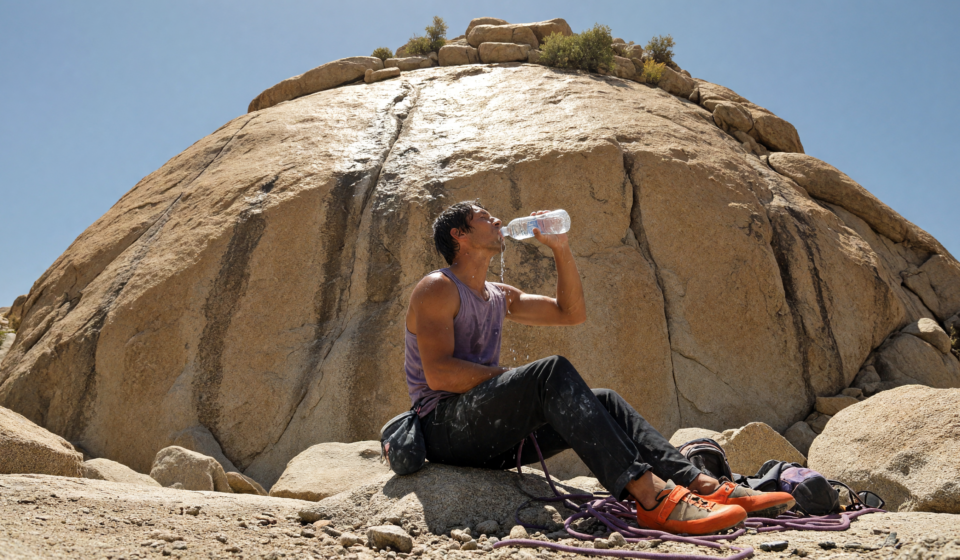
Hot-Weather Rock Climbing: Hydration, Approach Shoes and Rock Temps
By mid-morning in July, a south-facing granite face can be too hot to keep your palm on for more than a second or two, and the trail in was already baking when you left the car. Heat like that changes everything about a day on the rock: your body loses water faster than you notice, the stone that felt like sandpaper at dawn turns slick and greasy, and a casual approach hike becomes the most dangerous part of the outing. The rock does not care that you drove three hours to be there.
This guide covers what actually matters for summer rock climbing when temperatures climb: how to hydrate before you are thirsty, how to time your day around the heat index, how to choose and use approach shoes that keep you upright on hot, dusty trails, and how rock temperature and friction work against you when the stone bakes. We lean on guidance from the CDC, the National Weather Service, OSHA, and NIOSH for the human side, and on well-understood rubber and friction behavior for the gear side. The goal is simple: get you to the base safe, keep you climbing well, and get you home.
Why Summer Heat Raises the Stakes
Climbing is exercise, and exercise in the heat stacks two stresses on top of each other. Your working muscles generate heat, and a hot environment removes your body’s ability to shed it. The CDC notes that athletes exercising in high heat and humidity are at real risk of heat-related illness, and that the danger rises when the air is both hot and humid because sweat evaporates less efficiently. For summer rock climbing, that means the approach, the belaying in full sun, and the waiting between burns are all quietly draining you even when you are not moving hard.
The National Weather Service publishes the heat index precisely because air temperature alone understates the risk. Here is why the combination matters so much:
- Humidity blunts your cooling: when the air is already moist, sweat lingers on your skin instead of evaporating, so you overheat at lower temperatures than you would expect.
- Radiant heat from rock adds load: a sunlit wall re-radiates heat at you, so the temperature your body feels at the base can exceed the shaded air temperature.
- Effort compounds everything: the CDC lists heavy exertion as a key risk factor, and hauling a pack uphill in the sun is exactly that.
Hydration: Start Before You Are Thirsty
The single most repeated piece of guidance from the CDC on heat and athletes is also the easiest to ignore: drink more water than usual, and do not wait until you feel thirsty to start. Thirst lags behind actual fluid loss, so by the time your mouth is dry you are already behind. That deficit shows up as sloppy footwork, poor decision-making, and slower recovery between attempts long before it becomes a medical problem.
OSHA and NIOSH, which study heat stress in outdoor workers, echo the same principle: hydrate on a schedule rather than on demand, and take in fluids in small, frequent amounts rather than chugging a liter at the base. A few practical habits that carry over directly to a hot crag day:
- Pre-hydrate: start drinking well before you leave the car, so you arrive at the base topped off rather than trying to catch up.
- Sip often: small, regular pulls from a bottle or reservoir beat occasional big gulps, which your body absorbs less efficiently.
- Replace salts on long, sweaty days: when you are sweating heavily for hours, plain water alone can leave you low on electrolytes; the CDC notes that fluids with some sodium can help in prolonged exertion.
- Watch your urine: pale and frequent is the target; dark and infrequent means you are already behind.
👉 Shop hydration reservoir or insulated water bottle on Amazon (Ad — as an Amazon Associate, we earn from qualifying purchases.)
Reading the Heat Index and Timing Your Day
The cheapest safety gear you own is a good plan. The CDC’s advice for athletes in the heat is blunt: schedule activity for the cooler parts of the day and limit strenuous effort during the midday hours when the sun is most intense. On the rock, that usually means being at the base at first light and being packed up or in deep shade by early afternoon, not the other way around.
Before you commit to a crag, check two free tools. The National Weather Service forecast gives you the heat index for the day, and the CDC HeatRisk dashboard, developed jointly with the NWS, translates the forecast into a plain color-coded risk level for your area. Use aspect to your advantage, too: a west-facing wall stays cool through the morning, while an east-facing wall bakes early and mellows in the afternoon. Planning your route around sun and shade is not just about comfort; it directly reduces the heat load your body has to manage.
Field rule. If the forecast heat index lands in the National Weather Service’s warning range, treat the approach and any full-sun belays as the crux of the day, not the climbing. That is where heat illness usually starts, well before you tie in.
Approach Shoes: Grip That Gets You There Safely
Approach shoes exist for the awkward zone between hiking and climbing: loose talus, polished slabs, dusty switchbacks, and the occasional low-fifth-class scramble to the base. In summer that terrain is often at its most treacherous, because heat bakes trails into loose dust over hardpan and afternoon feet get tired and clumsy. A shoe built for this is not a luxury; it is the difference between a controlled descent and a sprained ankle far from the trailhead.
What separates a real approach shoe from a running shoe or a stiff hiker comes down to a handful of design features:
- Sticky rubber outsole: compounds like Vibram Megagrip and climbing-specific rubbers trade some durability for grip on smooth rock, which is exactly what you want on a polished slab.
- A climbing zone at the toe: a flat, low-profile patch of rubber at the front lets you edge on small features and smear on slab the way a hiking lug sole never could.
- A precise, secure fit: lacing that runs close to the toes keeps your foot from sliding forward on steep descents, which protects your toenails and your balance.
- Protective structure: a toe cap and a supportive midsole shield your feet from sharp talus and long, loaded approaches.
Fit matters more than any spec sheet. Try approach shoes on late in the day when your feet have swollen, wear the socks you actually climb in, and walk a decline in the store to confirm your toes are not jamming the front. A grippy sole cannot save a shoe that lets your foot slide around.
👉 Shop approach shoes with sticky rubber outsole on Amazon (Ad — as an Amazon Associate, we earn from qualifying purchases.)
Rock Temps and Friction: Why Hot Stone Feels Greasy
Every climber who has tried a slab problem in the heat knows the feeling: rubber that gripped perfectly at dawn suddenly skates off the same holds by noon. This is not in your head. Climbing rubber is a soft, temperature-sensitive compound, and it performs best in cool, dry conditions. As rock and rubber heat up, the rubber softens and deforms more easily, and the effective friction between shoe and stone drops. Cool, dry rock simply gives your rubber more to bite into.
Your hands tell the same story. In the heat you sweat onto the holds, and a film of moisture and skin oil sits between your fingers and the rock, which is why chalk becomes essential rather than optional. Practical ways to fight the heat-friction problem:
- Chase the shade: climb walls that are out of the sun, and prioritize routes early before the stone has soaked up hours of radiant heat.
- Let rubber cool between burns: keep your climbing shoes out of direct sun and off hot rock so the soles are not already warm when you tie in.
- Manage sweat aggressively: chalk up more often than you would in spring, and brush holds that have gone slick with skin oil.
- Respect the safety margin: reduced friction means a foot is more likely to blow unexpectedly, so climb within a bigger buffer and stay honest about run-outs.
👉 Shop chalk and refillable chalk bag on Amazon (Ad — as an Amazon Associate, we earn from qualifying purchases.)
Spotting Heat Illness on the Wall
Heat illness sits on a spectrum, and the early rungs are easy to write off as being tired or out of shape. The CDC flags muscle cramping as one of the first warning signs of heat-related illness, and advises stopping all activity and getting to a cool place the moment you feel faint or weak. Knowing where a partner is on that spectrum can decide whether a bad afternoon becomes a medical emergency.
The critical distinction, drawn from CDC guidance, is between heat exhaustion and heat stroke:
- Heat exhaustion: heavy sweating, cold and clammy skin, weakness, nausea, dizziness, and muscle cramps. Move the person to shade, cool them, and have them sip water; it is serious but usually manageable in the field.
- Heat stroke: a medical emergency marked by hot skin, confusion, and a loss of the ability to sweat normally. Per the CDC, call for emergency help immediately and cool the person as fast as possible while you wait.
- The judgment trap: heat degrades decision-making, so the affected climber is often the last to recognize the problem. Watch your partners, not just yourself.
Sun, Skin, and Gear in the Heat
Sun exposure at the crag is relentless because you are often stationary in the open for hours while belaying, and reflective rock bounces additional UV at you. The CDC recommends light-colored, loose clothing, shade, and sun protection during outdoor activity in the heat, all of which reduce both UV damage and your overall heat load. A wide-brim hat and a long-sleeve sun hoody do more work than most people expect, keeping direct sun off your skin without trapping heat.
Your gear needs heat management, too. A dark pack or a rope left on sunbaked rock gets genuinely hot, and prolonged heat is hard on the synthetic fibers in your soft goods over time. Keep the following in mind on scorching days:
- Stash gear in shade: keep ropes, harnesses, and shoes out of direct sun between climbs to protect both performance and longevity.
- Protect your electronics and food: a closed pack in full sun becomes an oven, so keep anything heat-sensitive insulated or shaded.
- Dress for the belay, not just the send: a sun hoody and hat make hours in the open sustainable rather than punishing.
👉 Shop sun hoody or wide-brim climbing hat on Amazon (Ad — as an Amazon Associate, we earn from qualifying purchases.)
The Bottom Line
Hot-weather climbing rewards planning far more than toughness. The climbers who have great summer days are not the ones who grind through the midday sun; they are the ones who arrive early, drink before they are thirsty, chase shade, choose approach shoes that keep them upright on baked-out trails, and accept that hot rock simply offers less friction than cool rock. Respect the heat index the way you respect a run-out, treat the approach and full-sun belays as the real crux, and watch your partners for the early signs of heat illness. Do that, and summer becomes a season to climb smart in, not one to survive. The rock will still be there when it cools down, and so, if you plan well, will you.
Disclaimer: This article is for general educational purposes only and is not medical, safety, or professional advice. Rock climbing is an inherently dangerous activity, and heat-related illness can be life-threatening. Always seek qualified instruction, follow manufacturer instructions for your gear, and consult a medical professional and current CDC and National Weather Service guidance regarding heat safety for your specific situation.
Sources: Centers for Disease Control and Prevention (CDC) — Heat and Athletes, and About Heat and Your Health; National Weather Service (NWS) — Heat Index and Outdoor Activities heat safety; CDC/NWS HeatRisk dashboard; Occupational Safety and Health Administration (OSHA) and the National Institute for Occupational Safety and Health (NIOSH) — heat stress and hydration guidance; Climbing Magazine — friction science and climbing shoe rubber.