Kmaier Infant Walkers Recalled Over Deadly Fall Hazard at the Edge of Steps
The U.S. Consumer Product Safety Commission (CPSC) and importer Kmaier announced an infant walker recall on August 27, 2026, pulling about 243 baby walkers off the market because they can roll toward stairs and fail to stop at the edge, a deadly fall hazard for the youngest children. The recalled units were sold on Target.com and violate the federal mandatory safety standard written specifically to keep walkers away from steps.
What happened
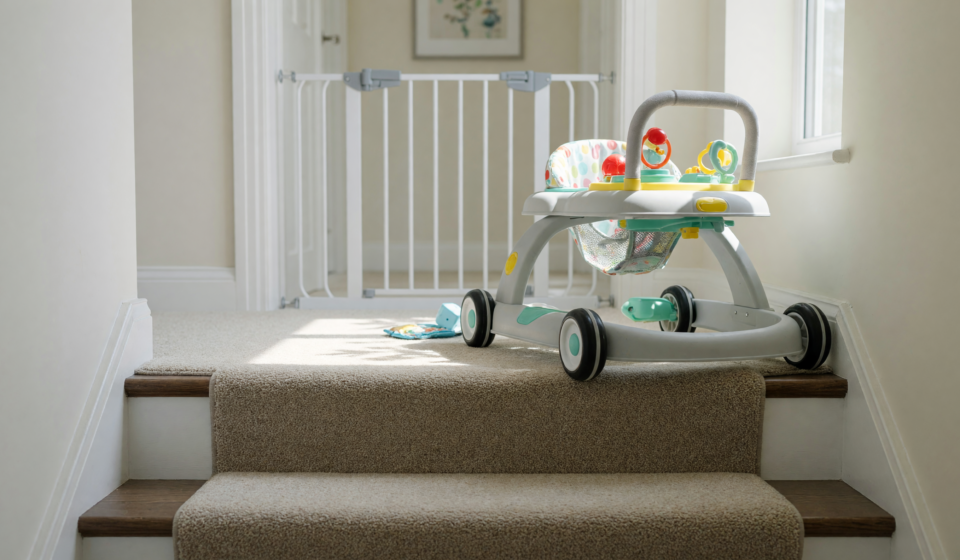
The recall covers Kmaier-branded infant walkers, model number RV001, sold in pink, green, or white with adjustable height levels. According to the CPSC notice (recall number 26-721), the walkers “can fit through a standard doorway and fail to stop at the edge of a step, posing a deadly fall hazard.” That combination is exactly what the federal rules are designed to prevent, and it is why the agency classifies the defect as a violation rather than a design quirk.
- Product: Kmaier infant walkers, model RV001, in pink, green, or white with adjustable height.
- Units: About 243.
- Sold at: Target.com in June 2026, priced between $62 and $70.
- Importer: FENUN, Inc., doing business as Kmaier, of Pasadena, California; manufactured in China.
- Injuries: None reported at the time of the recall.
No incidents or injuries had been reported when the recall was posted, which is the best time for a safety notice to reach families — before a preventable tragedy, not after. The small unit count also means many of these walkers are likely still in homes with parents who have no idea their child’s device was flagged.
Why this infant walker recall matters for safety
Infant walkers are among the most closely studied hazards in pediatric safety, and the numbers are sobering. A widely cited study published in Pediatrics by the American Academy of Pediatrics found that 230,676 children younger than 15 months were treated in U.S. emergency departments for walker-related injuries between 1990 and 2014. About 74 percent of those injuries happened when a child fell down stairs, and roughly 91 percent of injuries were to the head or neck — the worst possible outcome for a baby moving at speed toward a hard edge.
A walker gives a child who cannot yet walk the ability to cover several feet per second. Add an open doorway, an unguarded step, or a threshold the wheels can clear, and a curious infant can reach a fall before any adult can react. That is the precise scenario the recalled Kmaier walkers create, because they are narrow enough to pass through a standard doorway and lack the braking features that are supposed to stop a walker at the lip of a step.
What you should do
If you bought a Kmaier RV001 walker from Target.com, stop using it immediately and keep it away from your child. The CPSC directs owners to contact Kmaier for a full refund and to follow a specific disposal process to make sure the recalled walker never ends up back in use through resale or a hand-me-down.
What to do. Stop using the walker now. To get your refund, disassemble it, cut the fabric seat, and mark the tray with the word “Recalled.” Photograph the destroyed walker, email the photos to TargetplusSJ@outlook.com, then dispose of the pieces. Do not donate, resell, or store a recalled walker where a child could reach it.
Whatever walker you own, the everyday safety steps are the same: never use a walker near stairs, always block stairways with a securely mounted gate, and keep an adult within arm’s reach whenever a baby is in any mobility device. Many pediatric safety experts recommend stationary activity centers, which give babies the same play and upright time without wheels.
Context and what’s next
Since 2010, a federal mandatory rule (the Safety Standard for Infant Walkers, 16 CFR Part 1216) has required walkers to be too wide to fit through a standard doorway or to have features that stop them at the edge of a step. The rule has helped: AAP researchers found annual emergency-department injuries fell about 23 percent after the standard took effect. But the same research still counted more than 2,000 children treated each year, which is why the American Academy of Pediatrics continues to call for an outright ban on the manufacture and sale of infant walkers in the United States.
The Kmaier action is a reminder that a product can reach store shelves — even a major retailer’s online marketplace — while still failing that decades-old standard. For parents, the practical takeaway is straightforward: check the model number on any walker in your home, register products so you receive recall alerts directly, and treat stairs as the single greatest danger whenever a baby is on wheels.
Disclaimer. This article is for general safety information and is not a substitute for the official recall notice or medical advice. Details such as unit counts, models, and remedies can change as recalls are updated. Always confirm the current guidance directly with the CPSC and the manufacturer before acting.
Sources: CPSC recall 26-721 (Kmaier Infant Walkers); American Academy of Pediatrics, infant walker injury study; 16 CFR Part 1216, Safety Standard for Infant Walkers.