Concussions in Youth Sports: Helmets, Signs and Return-to-Play
Few moments make a parent’s stomach drop like watching a child take a hard hit on the field. In the seconds that follow, questions come fast: Was that a big deal? Should the game stop? And the one that matters most, is my kid okay? Youth sports concussions are more common than many families realize, and the good news is that most young athletes recover fully when the injury is recognized early and managed the right way. The trouble starts when a concussion is shrugged off, hidden, or rushed through.
This guide walks you through what a concussion actually is, why no helmet or mouthguard can make your child “concussion-proof,” and the specific signs to watch for on the sideline. We’ll cover exactly what to do in the first minutes after a suspected head injury, when to call 911, how medical evaluation and the graduated return-to-play process work, the often-overlooked return-to-learn piece, and the youth concussion laws that protect athletes in all 50 states. The goal is simple: to help you act with confidence, not fear.
What a Concussion Actually Is
A concussion is a mild traumatic brain injury, or mild TBI. It’s caused by a bump, blow, or jolt to the head, or by a hit to the body that makes the head and brain move rapidly back and forth. That quick motion can cause the brain to shift inside the skull, stretching brain cells and briefly disrupting how the brain works. The word “mild” refers only to the fact that a concussion is not usually life-threatening. It does not mean the injury is minor or that it can be ignored.
Two things surprise parents most. First, you do not have to lose consciousness to have a concussion. In fact, most concussions happen without any blackout at all. Second, symptoms don’t always appear right away. They can show up hours or even a day or two after the hit, which is exactly why ongoing observation matters so much.
The Myth of “Concussion-Proof” Gear
Here is the point every sports parent needs to hear clearly: helmets and mouthguards are important, but they cannot prevent concussions. A well-fitted, properly maintained helmet does a genuinely valuable job. It helps protect against skull fractures and serious, life-threatening head and brain injuries. What it cannot do is stop the brain from moving inside the skull when the head is jolted, and that internal movement is what causes a concussion.
The CDC is direct about this: there is no such thing as a concussion-proof helmet, and no mouthguard has been shown to prevent concussions either. Marketing claims that suggest otherwise can create a false sense of security, and a false sense of security is dangerous. It can lead athletes to play more aggressively or coaches to worry less, precisely when caution is called for.
The takeaway. Good gear reduces the risk of severe head injury and is absolutely worth using correctly. But no helmet, mouthguard, or piece of headgear can make your child immune to concussion. Avoiding unnecessary hits to the head is still the most effective protection.
👉 Shop certified sport helmet on Amazon (Ad — as an Amazon Associate, we earn from qualifying purchases.)
For gear to do its job, four things have to be true: the helmet fits properly, it’s well maintained and free of damage, it’s the right type for the sport and the athlete’s age, and it’s worn correctly and consistently every single time. A great helmet buckled loosely or worn over a hat protects far less than parents assume.
Signs and Symptoms to Watch For
The CDC splits concussion clues into two groups: observed signs, which are the things you notice as a coach, parent, or teammate, and reported symptoms, which are the things the athlete feels and tells you about. You need to pay attention to both, because a young athlete may not recognize or admit how bad they feel.
- Observed signs (what you see): the athlete appears dazed, stunned, or confused; can’t recall what happened before or after the hit; moves clumsily; answers questions slowly; loses consciousness even briefly; or shows mood, behavior, or personality changes.
- Reported symptoms (what they feel): headache or pressure in the head; nausea; balance problems or dizziness; blurry or double vision; sensitivity to light or noise; feeling foggy, sluggish, or “not right”; confusion; and trouble with concentration or memory.
- Delayed clues: irritability, sadness, nervousness, sleeping more or less than usual, or trouble falling asleep may surface hours later.
You do not need to see several of these to act. Even one new symptom after a blow to the head or body is enough reason to pull a young athlete out and take a closer look.
What to Do Immediately
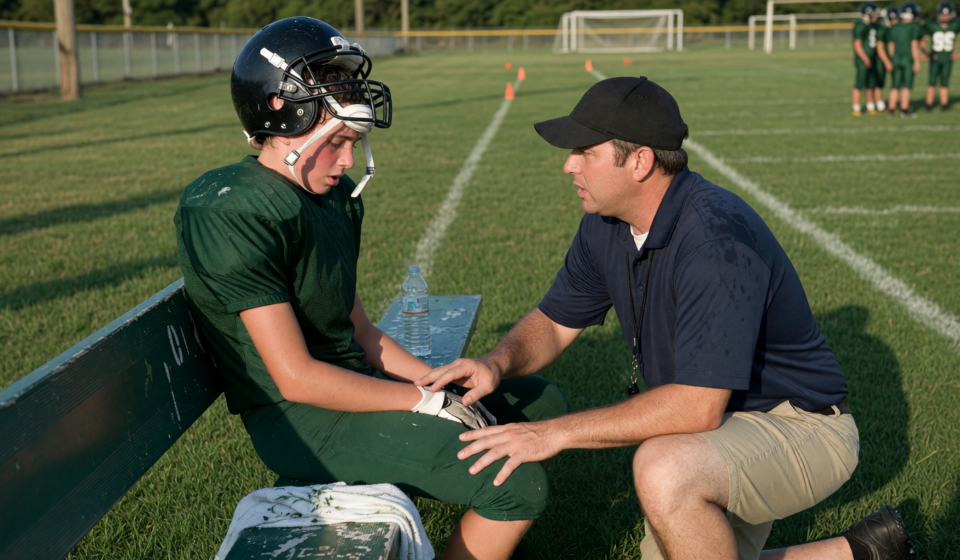
The guiding principle could not be simpler: when in doubt, sit them out. If you suspect a concussion, remove the athlete from play right away. Keep them out for the rest of that day, and do not let them return to sports until a healthcare provider has cleared them. Never try to judge the severity of a concussion yourself on the sideline, and never let an athlete “walk it off” back into the game. Continuing to play with a concussion can lead to a longer recovery and, in rare cases, catastrophic injury.
Some symptoms are medical emergencies. Call 911 or go to the emergency department right away if you notice any of these danger signs:
- One pupil larger than the other or double vision.
- Drowsiness or the inability to wake up or stay awake.
- A headache that keeps getting worse and will not go away.
- Slurred speech, weakness, numbness, or decreased coordination.
- Repeated vomiting or nausea, convulsions or seizures.
- Unusual behavior, increased confusion, restlessness, or agitation, or not recognizing people or places.
For infants and toddlers, add persistent crying that can’t be soothed and refusal to eat or nurse to that list. When any danger sign appears, do not wait to see if it passes.
Getting Evaluated
Every suspected concussion should be assessed by a healthcare provider trained in evaluating concussions, such as a pediatrician, sports medicine physician, or athletic trainer. Only a healthcare provider should judge the severity of the injury and decide when it’s safe to return. When you arrive, share the details: how the injury happened, what you observed, which symptoms appeared and when, and your child’s history of any previous concussions.
The early days of recovery usually call for a short period of relative rest, both physical and mental, followed by a gradual, symptom-guided return to normal activity. Your provider will give specific instructions tailored to your child, so keep that clearance in writing and share it with coaches and school staff.
👉 Shop certified sport mouthguard on Amazon (Ad — as an Amazon Associate, we earn from qualifying purchases.)
The Graduated Return-to-Play Steps
Returning to sports is a multi-step process that typically takes a week or more, and each step should be symptom-free before moving to the next. If symptoms return at any stage, the athlete drops back to the previous step and tries again after resting. A common approach, aligned with CDC guidance, looks like this:
- Step 1 – Back to regular activity: the athlete has returned to normal daily and school activities without symptoms or accommodations.
- Step 2 – Light aerobic activity: gentle movement like walking or stationary cycling to get the heart rate up, with no resistance training.
- Step 3 – Moderate, sport-specific activity: more intense but still non-contact drills, such as running or skating.
- Step 4 – Heavy, non-contact practice: harder training and non-contact drills, adding resistance work.
- Step 5 – Full-contact practice: return to normal training, only after written medical clearance.
- Step 6 – Return to competition: back to regular game play.
A crucial rule: an athlete must be back to all regular non-sports activities, without any accommodations, before finishing the return-to-sports protocol. In other words, school comes back before the scoreboard.
👉 Shop certified sport headgear on Amazon (Ad — as an Amazon Associate, we earn from qualifying purchases.)
Return to Learn: The School Piece
Concussions affect thinking, focus, and memory, which means the classroom deserves as much attention as the field. The return-to-learn process can happen at the same time as return-to-play, and for many kids it moves faster. A child may be ready for light schoolwork before they’re ready for sprints, and that’s exactly how it should work.
Talk with teachers, counselors, and the school nurse about temporary supports: shorter days, extra time on assignments, breaks from screens, a quieter environment, or postponed tests. These accommodations are meant to be short-term, easing off as symptoms improve. Watch for signs that schoolwork is worsening symptoms, like headaches that spike during reading, and loop your healthcare provider back in if progress stalls.
Youth Concussion Laws and Everyone’s Responsibilities
All 50 states and the District of Columbia now have youth concussion laws, modeled on Washington State’s 2009 Zackery Lystedt Law. Zack was a 13-year-old football player who suffered a devastating brain injury after returning to a game while still concussed. His story reshaped how the country handles young athletes’ head injuries.
While details vary by state, these Lystedt-type laws generally share three pillars: educating coaches, parents, and athletes about concussion each season; removing any athlete suspected of having a concussion from play immediately; and requiring written clearance from a licensed healthcare provider before that athlete can return. Coaches, parents, and athletes each carry part of the responsibility, coaches to enforce removal, parents to seek evaluation and honor recovery timelines, and athletes to speak up honestly about how they feel. A culture where reporting symptoms is respected, not penalized, keeps kids safest.
The Bottom Line
Concussions are a manageable part of youth sports when adults stay alert and act early. Use quality, well-fitted gear, but never treat it as a force field. Learn the observed signs and reported symptoms, pull any athlete with a suspected concussion out of play, and call 911 for danger signs. Get a proper evaluation, respect the graduated return-to-play and return-to-learn steps, and follow your state’s concussion law. Handled this way, the overwhelming majority of young athletes recover completely and get back to the games they love, on the brain’s timeline, not the season’s.
Disclaimer: This article is provided for general educational purposes only and is not medical advice. It is not a substitute for professional diagnosis, evaluation, or treatment. Any suspected concussion should be evaluated by a qualified healthcare professional. Always follow the guidance of your child’s provider and your state’s youth concussion laws.
Sources: CDC HEADS UP (Signs and Symptoms of Concussion; Responding to a Concussion; Helmet Safety); American Academy of Pediatrics (AAP) concussion guidance; state youth concussion laws, including Washington State’s Zackery Lystedt Law (RCW 28A.600.190).