
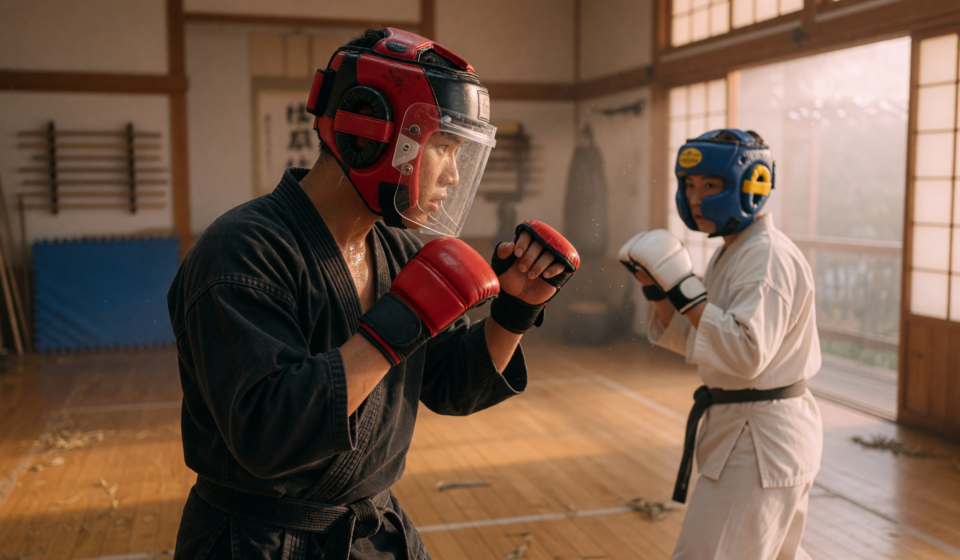
Martial Arts Headgear: Foam-Dipped vs Padded for Sparring
You feel it before you hear it: a roundhouse you never saw coming clips the side of your head, the room tips for half a second, and you finish the round running on instinct. Anyone who has sparred long enough knows that moment, and it is exactly why the right martial arts headgear matters. Head protection will not turn you into an untouchable robot, but the difference between the wrong guard and the right one is the difference between shrugging off a shot and walking off the mat with a split lip, a ringing ear, or worse.
This guide breaks down the two families of gear you will actually shop for: foam-dipped headgear and padded headgear. We will cover how each one is built, what it is genuinely good at, where it falls short, and how governing bodies like World Taekwondo, USA Taekwondo, and USA Boxing treat them. By the end you will know which style fits your discipline, your contact level, and your face, plus the honest limits of what any headgear can and cannot do.
What Headgear Is Actually Protecting
Before comparing materials, it helps to be clear about the job. Sparring headgear is very good at spreading out and softening the sharp, surface-level trauma that ends training sessions early: cuts, scrapes, swollen ears, bruised cheekbones, and the sting of a knuckle or shin bone landing on bare skin. It cushions the accidental clash of heads in a clinch and takes the edge off a glancing blow.
What headgear does not reliably do is stop your brain from moving inside your skull. A concussion is largely a product of the head accelerating and rotating, and foam padding can only do so much to slow that down. The Association of Ringside Physicians and public-health resources like the CDC HEADS UP program are consistent on this point: headgear reduces superficial injuries, but no head guard should be treated as concussion-proof. Keep that in mind as we compare the two styles, because the smartest choice is the one that protects what it can while you train smart about the rest.
Foam-Dipped Headgear: How It Works
Foam-dipped headgear is the molded, one-piece guard you see across sport karate and traditional taekwondo schools. It is made by dip-molding a foam core, usually a dense vinyl or EVA-type foam, into a single continuous shell with a smooth outer skin. There is no fabric cover and no separate padding layers to shift around. What you see is what absorbs the hit.
That construction gives foam-dipped gear a distinct personality on the mat:
- Lightweight and low-profile: The single-piece design sits close to the head, so it feels quick and rarely throws off your timing on fast, snappy techniques.
- Great for point and semi-contact: It shines in disciplines where strikes are controlled and pulled, cushioning the occasional over-committed shot rather than a steady stream of power punches.
- Easy to clean: The smooth, non-porous surface wipes down with a disinfectant in seconds, which matters for shared school gear.
- Consistent coverage: Because it is molded, the padding will not bunch, fold, or slide out of place mid-round.
- Softer, grippier surface: The tacky outer skin is designed to give slightly on contact rather than deflect, which suits light-contact rule sets.
The trade-offs are just as real. Dipped foam compresses fast, so it does less to blunt heavy, repeated impact, and it tends to wear out sooner as the foam takes a set. Open-face models leave the nose and mouth exposed, and the same soft surface that feels good in point fighting can drag against a glove in faster continuous exchanges.
👉 Shop foam-dipped karate/taekwondo sparring headgear on Amazon (Ad — as an Amazon Associate, we earn from qualifying purchases.)
Padded Headgear: How It Works
Padded headgear is the boxing-style guard: a shaped foam core wrapped in a synthetic leather or vinyl shell, often with layered or multi-density padding underneath. Instead of one molded piece, you get engineered zones of cushioning stitched into a cover, with adjustable straps at the chin and back and frequently extra material over the cheeks. This is the family you see in boxing, kickboxing, Muay Thai, and harder-contact mixed martial arts sparring.
Here is where padded gear earns its keep:
- More coverage: Cheek padding and taller side walls protect the temples, jaw, and orbital area, and face-saver or bar models add a barrier across the front.
- Better with heavy contact: Thicker, layered foam handles repeated power shots more gracefully than thin dipped foam, which is why continuous-sparring gyms favor it.
- Adjustable fit: Laces, hook-and-loop straps, and tunable closures let you dial in a snug, custom hold that stays put.
- Durable shell: The synthetic-leather cover resists abrasion and generally outlasts an exposed foam surface.
- Replaceable feel: Because the padding is engineered in zones, higher-end models balance protection against the visibility you need to see the next strike.
The costs are extra bulk and, with the most protective face-saver designs, reduced peripheral vision. More padding can also mean more head to hit, and a larger target that traps heat. And, as with every style, the thick cushioning still does not neutralize the rotational forces behind a concussion.
👉 Shop boxing-style padded sparring headgear with cheek protection on Amazon (Ad — as an Amazon Associate, we earn from qualifying purchases.)
How to Choose Martial Arts Headgear for Your Style
The single most useful question is not “which is safer” in the abstract, but “what does my training actually look like.” Contact level and discipline point you to the right martial arts headgear far more reliably than price does.
- Point and semi-contact karate or taekwondo: Foam-dipped is the natural fit. It is light, legal in most sport-karate rings, and matched to controlled contact.
- Continuous, kickboxing, Muay Thai, or MMA sparring: Padded gear handles the volume and power far better, and cheek coverage protects against elbows and clinch knees.
- Amateur boxing: Follow USA Boxing rules, which specify approved competition headgear; padded boxing-style guards are the category built for it.
- Olympic-style taekwondo: World Taekwondo and USA Taekwondo competition uses designated red or blue head protectors, sometimes with electronic scoring sensors, so buy to the rule set your tournaments follow.
- Beginners drilling light contact: A comfortable, easy-to-clean foam-dipped guard lowers the barrier to putting gear on every session, which is the habit that actually matters.
Rule of thumb. Match the guard to the hardest contact you regularly take, not the lightest. If your gym runs occasional hard rounds, gear up for those rounds, because the one session you under-protect is the one that hurts.
What the Governing Bodies and Standards Say
If you compete, the choice may be made for you, so it pays to read your organization’s rulebook before you spend a dollar. In the United States, a few authorities set the tone:
- World Taekwondo and USA Taekwondo: Olympic-style competition uses standardized head protectors in red or blue, and higher levels increasingly rely on electronic protector and scoring systems, so the approved list is narrow.
- USA Boxing: As the national governing body for amateur boxing, it specifies which headgear is permitted in sanctioned bouts and how it must fit; training gyms often mirror those requirements.
- ITF and traditional taekwondo: International Taekwon-Do Federation events maintain their own approved-equipment lists, generally centered on dipped-foam guards.
- ASTM International: This standards organization develops voluntary test methods for sports protective equipment in the U.S., and reputable brands design to recognized performance benchmarks even where a specific sport does not mandate certification.
- Association of Ringside Physicians: Its position statements guide combat-sports medical policy, including the realistic role and limits of headguards.
The practical takeaway: certification and approval are discipline-specific. A guard that is perfect for your kickboxing class may be illegal in a taekwondo ring and vice versa. When in doubt, ask your coach which exact models pass inspection at the events you plan to enter.
Fit, Coverage, and Care
Whichever style you pick, fit is the multiplier. A top-tier guard that slides over your eyes mid-round protects you less than a modest one that stays locked in place. Focus on the fundamentals:
- Snug, not crushing: The guard should hold position when you shake your head hard, without pinching or giving you a headache after two rounds.
- Clear sightlines: You must see a straight punch and a rear-leg kick coming; if the padding blocks your peripheral vision, size down or change models.
- Stable closures: Check that chin and rear straps stay set. Anything that creeps loose is a shot waiting to land.
- Pair it with a mouthguard: Headgear guards the outside of the skull; a fitted mouthguard protects your teeth and jaw and is a standard part of the kit.
- Clean and inspect often: Wipe gear down after every session and retire any guard whose foam has gone flat, cracked, or permanently compressed.
👉 Shop fitted sparring mouthguard on Amazon (Ad — as an Amazon Associate, we earn from qualifying purchases.)
The Bottom Line
There is no universal winner here, only the right tool for your training. Foam-dipped headgear is the light, quick, easy-to-clean choice for point and semi-contact karate and taekwondo, where it cushions the occasional clean shot without slowing you down. Padded, boxing-style headgear is the heavier-duty answer for continuous, kickboxing, Muay Thai, and MMA sparring, where volume and power demand real coverage over the cheeks and temples. Buy for the hardest rounds you actually take, follow your discipline’s approved-equipment rules, insist on a fit that stays put, and pair the guard with a mouthguard. Do that, and your headgear does its real job: keeping the small injuries small so you can keep showing up to train, spar smart, and treat your head like the piece of equipment you can never replace.
Disclaimer: This article is for general educational purposes only and is not medical, legal, or safety-certification advice. It does not guarantee protection from injury, including concussion. Always follow the rules of your governing body, the guidance of your coach and physician, and the manufacturer’s instructions for any protective equipment you buy or use.
Sources: World Taekwondo; USA Taekwondo; USA Boxing; International Taekwon-Do Federation (ITF); ASTM International; Association of Ringside Physicians (headguard position statement); U.S. Centers for Disease Control and Prevention (CDC) HEADS UP concussion program.