Leaf Blower Safety: Hearing, Eye and Debris Protection
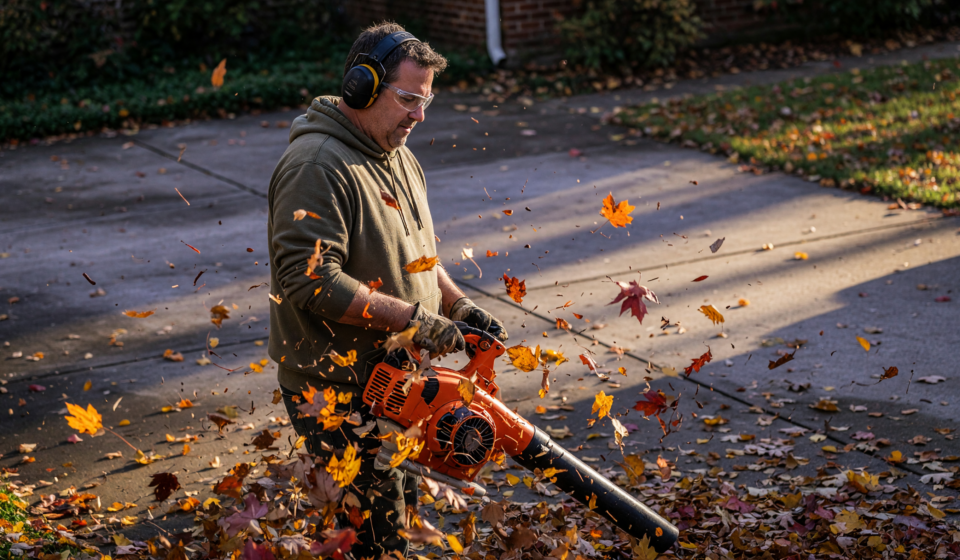
The first cool Saturday of fall, you fire up the blower, and within seconds a wall of sound wraps around your head while a plume of grit, grass clippings, and dried leaf dust kicks up in front of your face. It feels routine, almost harmless. But that everyday roar is exactly why leaf blower safety deserves more thought than most homeowners give it. A blower concentrates high noise, high-speed air, and airborne debris into one tool you hold inches from your ears and eyes for an hour or more at a stretch.
This guide walks through the three risks that matter most with a blower in your hands: hearing damage, eye injury, and airborne debris and dust. We will explain the “why” behind each recommendation in plain English, lean on U.S. standards and agencies like OSHA, NIOSH, and the ANSI/ISEA Z87.1 eyewear standard, and help you build a simple kit. Good leaf blower safety is not about fear; it is about spending five dollars and thirty seconds so a routine chore does not quietly cost you something you cannot get back.
Why a Leaf Blower Is Louder Than It Feels
Noise is measured in decibels on the A-weighted scale (dBA), and the scale is logarithmic, so small-looking numbers hide big jumps in intensity. Many gas-powered blowers run loud enough to push past the thresholds that safety agencies treat as hazardous. OSHA sets its permissible exposure limit at 90 dBA averaged over an eight-hour workday, and its “action level,” the point at which employers must start a hearing conservation program, at 85 dBA over eight hours. NIOSH, the research arm behind much of this science, recommends keeping exposure below 85 dBA for eight hours to minimize the risk of hearing loss.
Here is the part that should get your attention. According to NIOSH and OSHA, loud noise damages the tiny hair cells inside the cochlea of your inner ear, and once those cells are destroyed, the hearing loss is permanent. It cannot be fixed with surgery or medicine. The damage is also cumulative and painless, which is precisely why so many people ignore it until it is too late.
- The scale is deceptive: Every 3 dBA increase roughly doubles the sound energy hitting your ears, so a blower that seems “just a little louder” than a lawn mower can be meaningfully more harmful.
- Time matters: The louder the sound, the less time you can safely be exposed before risk climbs.
- It is silent damage: Noise-induced hearing loss rarely hurts in the moment, so you cannot rely on discomfort to warn you.
Where Leaf Blower Safety Starts: Your Ears
Because hearing loss is permanent, protecting your ears is the single highest-value habit in leaf blower safety. In the United States, hearing protectors carry a Noise Reduction Rating (NRR), a number in decibels that the EPA requires on the packaging. A higher NRR indicates more potential attenuation in laboratory testing. Real-world performance is usually lower than the label because of imperfect fit, so treat the NRR as a ceiling rather than a promise, and prioritize a good, consistent seal over chasing the biggest number.
- Foam earplugs: Inexpensive and compact. Roll them down, insert deep into the canal, and hold until they expand for a proper seal.
- Earmuffs: Easy to slip on and off between passes, and they seal reliably as long as nothing breaks the cushion against your head, such as eyewear arms or a hat brim.
- Double protection: For very loud gas units or long sessions, wearing plugs under muffs adds meaningful protection.
- Fit beats spec: A protector that seals well every time outperforms a higher-rated one you wear loosely.
👉 Shop NRR-rated earmuffs and foam earplugs for yard work on Amazon (Ad — as an Amazon Associate, we earn from qualifying purchases.)
Rule of thumb. If you have to raise your voice to be heard by someone an arm’s length away, the noise around you is loud enough to warrant hearing protection. A running leaf blower clears that bar easily.
Protecting Your Eyes From Flying Debris
A blower’s whole job is to move material at high speed, and it does not discriminate between a leaf and a pebble, a wood chip, an acorn, or a shard of mulch. Any of those can be launched toward your face or bounced back off a wall or fence. Everyday prescription glasses and fashion sunglasses are not built to stop a fast-moving object; they can shatter and make an injury worse.
The U.S. benchmark for protective eyewear is the ANSI/ISEA Z87.1 standard, updated most recently in its 2025 edition. Eyewear that meets it is marked “Z87” on the frame or lens, and eyewear that passes the high-impact test carries a “Z87+” marking. For blower work, look for that plus sign, and choose a wraparound style or add side shields so debris cannot sneak in from the edges.
- Look for Z87+: The plus sign signals the lens passed high-velocity impact testing, which is what you want around thrown debris.
- Choose wraparound coverage: Side protection matters because material ricochets from unpredictable angles.
- Consider a face shield for heavy jobs: When you are blowing gravel-strewn driveways or dry, dusty beds, a shield worn over safety glasses adds full-face coverage.
- Anti-fog helps compliance: Eyewear you can actually see through is eyewear you will keep on.
👉 Shop ANSI Z87+ rated wraparound safety glasses on Amazon (Ad — as an Amazon Associate, we earn from qualifying purchases.)
Guarding Your Lungs Against Dust and Mold
Dry leaf piles, especially older ones that have been sitting and decomposing, hold a surprising amount of fine dust, mold spores, pollen, and animal droppings. A blower aerosolizes all of it and puts it right in your breathing zone. For most people this is an irritant; for anyone with asthma, allergies, or a compromised immune system, it can be a genuine health concern.
A NIOSH-approved N95 particulate respirator is a sensible, low-cost safeguard for dusty conditions. The N95 designation means the device is certified to filter at least 95 percent of airborne particles when it fits properly. Look for the NIOSH approval markings, make sure it seals against your face, and note that facial hair along the seal line undermines the fit. On a still, humid day with wet leaves, dust is minimal and a mask may be optional; on a dry, breezy day over old debris, it earns its place.
- Match the mask to the day: Dry, dusty, decomposing material calls for a respirator; damp, freshly fallen leaves throw far less into the air.
- Check for NIOSH approval: A genuine N95 carries NIOSH markings and an approval number.
- Mind the seal: A mask only filters what passes through it, so gaps around the nose and cheeks defeat the purpose.
👉 Shop NIOSH-approved N95 particulate respirators on Amazon (Ad — as an Amazon Associate, we earn from qualifying purchases.)
Dressing the Rest of You for the Job
Your ears, eyes, and lungs get the headlines, but a few clothing choices round out the picture. High-speed air chills exposed skin, whips small debris against your arms and legs, and, with backpack units, puts real weight and vibration on your body. A little coverage goes a long way toward finishing the job comfortably and without nicks and scrapes.
- Closed shoes, not sandals: Sturdy footwear protects your feet from anything the blower flings backward or downward.
- Long sleeves and long pants: A simple barrier against grit, thorns, and the sandblasting effect of the airstream.
- Work gloves: They cut vibration fatigue, improve grip on the throttle, and protect your hands while you clear jams.
- Skip loose items: Dangling drawstrings, scarves, and untied long hair have no place near moving equipment.
👉 Shop anti-vibration work gloves for yard tools on Amazon (Ad — as an Amazon Associate, we earn from qualifying purchases.)
Fumes, Fuel, and Smart Technique
Gas-powered blowers, particularly two-stroke models, burn a fuel-and-oil mix and produce exhaust that includes carbon monoxide, an odorless gas that is dangerous in enclosed spaces. Never run a gas blower inside a garage, shed, or any poorly ventilated area, even with the door cracked. Handle fuel outdoors, let a hot engine cool before refueling, and store gas in an approved container away from ignition sources.
Technique protects both you and the people nearby. Where you point the nozzle and when you run the machine are safety decisions, not just etiquette. A few habits keep debris under control and keep the peace with neighbors.
- Aim low and downwind: Keep the nozzle close to the ground and work with the breeze to avoid throwing debris back at yourself.
- Sweep, do not blast: Lower throttle settings move leaves with less noise, less dust, and less flying gravel.
- Clear the area first: Scan for stones, wire, and pet waste before you start, and keep bystanders and pets well back.
- Consider electric or battery units: They generally run quieter and produce no engine exhaust, which reduces two of the three main hazards at once.
Looking Out for Everyone Nearby
The hazards from a blower do not stop at arm’s length. High-velocity air can throw a stone across a yard, and the noise reaches everyone within earshot, including children and pets whose ears are more sensitive than yours. A moment of awareness protects the people you would least want to hurt.
- Keep a clear zone: Ask children and pets to stay indoors or well away while the blower is running.
- Watch your line of fire: Never point the nozzle toward people, animals, windows, or parked cars.
- Mind the hours: Many communities have noise ordinances, and blowing at a reasonable time of day is both courteous and often required.
The Bottom Line
A leaf blower is one of the most convenient tools in the shed and one of the easiest to underestimate. The three big risks, permanent hearing loss, eye injury from flying debris, and lungfuls of dust and mold, are all real, and all are cheap and simple to guard against. Slip on hearing protectors with a solid seal, put on Z87+ safety glasses, keep an N95 handy for dusty piles, dress with a little coverage, and mind your technique and the people around you. None of it slows you down in any way you will notice. Do it every time, make it a habit rather than a decision, and you can keep enjoying that first crisp Saturday of fall for many autumns to come, hearing and eyesight fully intact.
Disclaimer: This article is for general educational purposes only and does not constitute professional safety, medical, or legal advice. Always read and follow the manufacturer’s instructions for your specific equipment and personal protective gear, and consult a qualified professional for guidance on your particular situation.
Sources: Occupational Safety and Health Administration (OSHA), Occupational Noise Exposure; National Institute for Occupational Safety and Health (NIOSH) / CDC, Noise and Hearing Loss; U.S. Environmental Protection Agency (EPA), Noise Reduction Rating labeling requirements; ANSI/ISEA Z87.1 standard for occupational and educational eye and face protection; NIOSH-approved respirator guidance (CDC).