Water-Ski and Wakeboard Protection: Vests, Helmets and Hand Signals
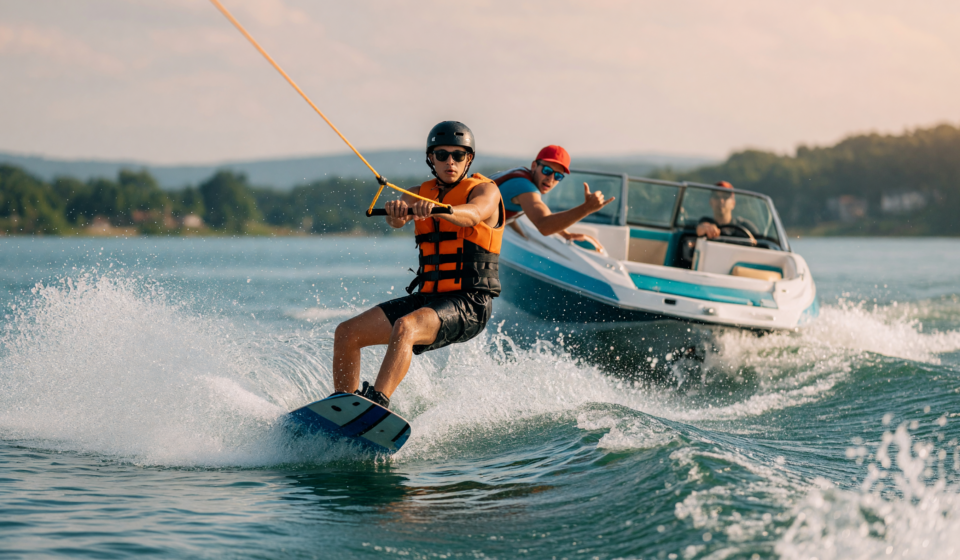
A hard fall behind a boat does not feel like falling into water. At 20 or 30 miles per hour, the surface pushes back like a sidewalk, and a rider who goes down disoriented can surface facing the wrong way while a heavy inboard idles somewhere nearby. This is exactly why the right wakeboard protective gear is not an accessory or a fashion choice. A properly fitted vest keeps your head above water when you are stunned, a helmet blunts an impact you never saw coming, and a shared set of hand signals means the person driving the boat knows in a heartbeat whether you are fine or in trouble.
This guide walks through the three pillars of towed-watersports safety in plain English: personal flotation devices (PFDs), helmets, and hand signals. We will cover the new U.S. Coast Guard life jacket labeling system, the difference between a Coast Guard-approved vest and a foam impact vest, when a helmet actually earns its place on the water, and the standard signals that keep the skier and the boat crew on the same page. The goal is not to scare you off the water. It is to help you understand the why behind each piece of gear so you make smart calls before you ever grab the rope.
Why the Vest Comes First
Of everything you strap on, the life jacket does the most to keep you alive. The U.S. Coast Guard requires that anyone being towed on skis, a wakeboard, a tube, or similar device wear an approved PFD, and every state layers its own rules on top of that federal baseline. A vest does two jobs at once: it floats you when you are dazed and cannot swim well, and the better designs add a layer of padding that absorbs some of the smack of a high-speed fall. When you consider that a wipeout can knock the wind out of you or briefly rattle your senses, the value of gear that floats you face-up without any effort on your part becomes obvious.
Fit is what makes a vest work. A jacket that rides up over your ears when you are lifted by the shoulders is too loose, and a loose vest can slip off entirely during a hard tumble. Look for a snug fit through the chest, closed buckles and zippers, and straps cinched so the vest stays put when you tug up on the shoulders.
- Snug, not tight: You should be able to breathe and rotate freely, but the vest should not lift past your chin when pulled upward.
- Closed and secured: Zip, buckle, and cinch every closure before you launch; an unfastened vest is little better than none.
- Sized for the wearer: Adult vests are sized by chest measurement, while youth and child vests are rated by body weight, so match the label to the person.
- Inspected each season: Retire any vest with torn fabric, crushed foam, or failing straps, because damaged flotation is unreliable flotation.
👉 Shop Coast Guard-approved watersports life vest on Amazon (Ad — as an Amazon Associate, we earn from qualifying purchases.)
Understanding the New U.S. Coast Guard PFD Labels
If you shopped for a life jacket a few years ago, you probably remember the old Type I through Type V labels. As of early 2025, the Coast Guard has moved to a new system that aligns U.S. life jackets with international (ISO) standards. Instead of Roman-numeral types, approved devices now carry a performance level based on their buoyancy, measured in newtons. The older Type-labeled vests you already own remain legal to use; the change mainly affects how new products are marked and sold.
For towed watersports, two levels matter most. Lower-buoyancy devices are built to be worn during active sports like wakeboarding and only provide their rated protection while you are wearing them. General-purpose recreational vests carry more buoyancy and are the everyday choice for calm inland and nearshore waters. The practical takeaway is simple: read the label, confirm the device is Coast Guard approved for your activity and body size, and make sure it is rated to be worn rather than merely stowed.
- Look for the approval statement: A genuine PFD carries a printed Coast Guard approval and a use label describing what it is designed for.
- Match the level to the water: Sport-oriented vests suit active riding on protected water; higher-buoyancy vests suit open, rougher conditions.
- Old labels still count: A serviceable Type III vest you bought earlier is still legal; you do not have to rush out and replace it.
- Children have stricter rules: Child-rated devices and state age rules govern young riders, so never put a kid in an adult vest to save time.
Impact Vests Versus Coast Guard-Approved Life Jackets
Here is a distinction that trips up a lot of riders. The slim, low-profile “comp” or impact vests you see advanced wakeboarders wearing are built for freedom of movement and to soften impact, but many of them are not Coast Guard approved as flotation. They are neoprene-and-foam garments designed to spread out the force of a fall, not to reliably float an unconscious person face-up. If a vest is not stamped with a Coast Guard approval, wearing it does not satisfy the legal requirement to have an approved PFD on the person being towed.
That does not make impact vests useless. On the contrary, the padding is genuinely valuable for the ribs and torso during hard cable-park or wake sessions. The point is to know which garment you are wearing and why. Recreational riders are almost always best served by a Coast Guard-approved vest that also offers impact padding, so you get flotation and cushioning in one legal package. If you choose a non-approved impact vest for its fit, understand that you are trading away the flotation guarantee that could matter most on your worst day.
Know before you tow. A stylish impact vest that lacks a U.S. Coast Guard approval label will not keep you legal or reliably float you if you are knocked out. When in doubt, choose an approved vest that also provides impact padding, and save the non-approved comp vest for supervised, closed-course riding.
👉 Shop wakeboard impact vest with Coast Guard approval on Amazon (Ad — as an Amazon Associate, we earn from qualifying purchases.)
Helmets: When You Need One and What to Look For
Helmets are not required for open-water skiing the way they are for cycling in many places, but there are clear situations where they belong on your head. Cable parks and wake parks, where riders hit ramps, rails, and other fixed features, are the obvious cases; many parks require a helmet for exactly that reason. Riders working on tricks, anyone boarding in crowded water where board-to-head contact is possible, and children still building their balance all benefit from head protection. The physics do not care whether you are on a lake or a cable course: a head striking hard water or a board at speed can be seriously injured.
A watersports helmet is a different animal from a bike helmet. It needs to drain water quickly, resist waterlogging, and stay secure through repeated dunkings. In Europe, the reference standard for canoeing and white-water helmets is CE EN 1385, and many watersports helmets are built and marketed against it. The United States does not have a single dedicated federal standard for wakeboard helmets, so look for a helmet purpose-built for watersports rather than a repurposed skate or bike lid that can fill with water and drag on your neck.
- Purpose-built for water: Choose a helmet designed to shed water and resist absorption, not a dry-land helmet pressed into service.
- Secure, comfortable fit: It should sit level, cover the forehead, and stay snug without a chin strap that chokes or a shell that spins.
- Drainage matters: Ports or channels that let water escape keep the helmet from becoming a heavy, neck-straining bucket.
- Replace after a real hit: Foam that has absorbed a hard impact may not protect you the same way twice, even if the shell looks intact.
👉 Shop watersports wakeboard helmet on Amazon (Ad — as an Amazon Associate, we earn from qualifying purchases.)
Hand Signals: The Language Between Skier and Boat
Gear protects your body, but communication protects the whole outing. A skier cannot shout over an engine and a boat crew cannot read a rider’s mind, so towed watersports rely on a small, standardized set of hand signals. Everyone in the boat and everyone getting in the water should agree on these before the first pull. They are simple, they are widely taught by boating-safety organizations, and they remove dangerous guesswork at speed.
- Thumb up: Speed up; the rider wants the boat to go faster.
- Thumb down: Slow down; ease off the throttle.
- Flat hand out to the side: Speed and conditions are good, keep it steady.
- Hand slashing across the throat: Cut the motor or stop now.
- Patting the top of the head: Return to the dock.
- Hands clasped overhead: The skier is OK after a fall.
- A ski or arm held straight up in the water: Skier down; alert other boaters to a person in the water.
The most important signal is the one a fallen rider gives immediately: clasping both hands over the head to show the crew “I’m okay.” If that signal does not come, the crew treats it as an emergency and moves to recover the skier. Agree on your signals out loud before you launch, and make sure any first-time observer knows them cold.
The Observer Rule and Why It Exists
A boat driver towing a rider cannot safely watch the water ahead and the skier behind at the same time. That is why most states require a second set of eyes. The typical rule is that the boat must carry a competent observer, often required to be at least 12 years old, who watches the skier and relays signals to the operator. Many states allow a wide-angle rearview mirror as an alternative to a human observer, and some require both. Because these rules vary, check the regulations for the state where you are boating before you head out.
- Assign a dedicated observer: Their only job is to watch the rider and communicate with the driver, not to run the stereo.
- Know your state’s minimum age: Many states set a minimum observer age, commonly around 12, so confirm before you rely on a younger passenger.
- Mirror rules differ: A rearview mirror satisfies the law in some states, supplements an observer in others, and is not enough on its own in some places.
- Ski in daylight only: States generally prohibit towing between sunset and sunrise, so plan your sessions for good light.
Ropes, Handles, and Smart Habits
The gear between you and the boat deserves attention too. A frayed rope can snap under load, and a cracked handle can fail at the worst moment. Inspect the tow line and handle before each outing, keep the rope clear of the propeller when a rider is down, and never wrap the line around any part of your body. Give riders a wide berth from docks, swimmers, and other boats, and keep at least the length of the tow rope plus a safe margin between the skier and any fixed object.
Good habits cost nothing and prevent the majority of avoidable incidents. Approach a downed skier from the side, shut off the engine before anyone climbs aboard, and display a skier-down flag where your state requires it. None of this slows down a good day on the water; it just keeps the day from turning into a bad one.
The Bottom Line
Water skiing and wakeboarding reward preparation. Start with a Coast Guard-approved vest that fits snugly and, ideally, adds impact padding; understand that a slick comp vest may look the part without meeting the legal or flotation standard. Add a purpose-built watersports helmet whenever you are riding features, learning tricks, or sharing crowded water. Then close the loop with communication: a dedicated observer, a rearview mirror where the law calls for it, and a set of hand signals every person in the boat knows by heart. Do those three things, respect your state’s rules, and you give yourself the best possible odds of ending every session the way it started, tired, grinning, and unhurt.
Disclaimer: This article is provided for general educational purposes only and does not constitute legal, medical, or professional safety advice. Boating and towed-watersports laws vary by state and change over time; always confirm current U.S. Coast Guard requirements and the regulations of the state where you operate, and follow the instructions supplied with your specific gear.
Sources: U.S. Coast Guard (Office of Boating Safety and PFD Selection guidance, including the 2025 transition to performance-level PFD labeling); U.S. Coast Guard state boating-law summaries on water-skiing observer and mirror requirements; BoatUS Foundation boating-safety guidance on life jackets and water-skiing hand signals; CEN standard CE EN 1385 for canoeing and white-water sport helmets; state boating agencies for observer age and skier-down requirements.