Karting Safety Gear: Rib Protectors, Neck Braces and Summer Cooling
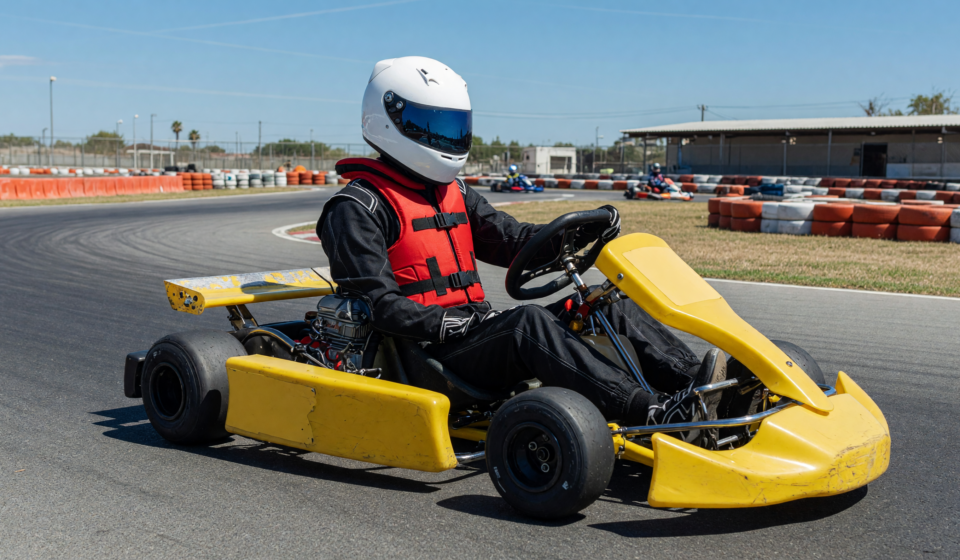
Anyone who has driven a shifter kart on a hot July afternoon knows the truth that spectators miss: a kart with no suspension and a seat bolted a few inches off the pavement transmits every bump, curb, and cornering load straight into your body. At 40 to 60 miles per hour and pulling real lateral g’s, a racing kart is one of the most physical machines in motorsport, and the right karting safety gear is what stands between a great weekend and a cracked rib or a heat-related trip to the medical tent. This guide walks through the equipment that actually matters.
Below we cover the core protective kit for karting in plain English: helmets and the rating systems that govern them, rib protectors and the newer FIA body-protection standard, neck braces and head restraints, plus gloves, suits, and the fire question. Then we tackle the part most buying guides skip entirely, summer cooling and hydration, because on a triple-digit day the heat is a safety hazard just as real as another driver’s front bumper. Standards and sanctioning rules change, so always confirm what your specific series requires before you buy.
Start With the Helmet: Snell, CMR and Why the Rating Matters
Your helmet is the one piece of gear no serious kart club will let you skip, and not all helmets are created equal. In the United States, the certifications you will see most often come from the Snell Memorial Foundation and the FIA. A basic DOT motorcycle helmet is generally not the right tool for the job, because motorsport standards address impacts, fire exposure, and shell rigidity in ways street standards do not. Here is how the common labels break down.
- Snell SA (Special Application): The auto-racing family, such as SA2020 and SA2025. These helmets include a flame-resistant liner and are built for closed-course competition; many karting series accept them.
- Snell CMR / CMS (youth): The Children’s Motorsport Restricted and Standard ratings, including CMR2016, are designed for young drivers and are frequently required for racers under 15. They limit helmet mass to reduce neck loading on smaller bodies.
- Snell K: A karting-specific family for tracks without fire risk, so it may omit fire testing that SA helmets include. Confirm your series accepts it.
- FIA-homologated: Helmets meeting FIA standards such as the 8859 or 8860 families, sometimes mandated for higher-level or international competition.
Whatever label you chase, fit trumps everything. A helmet that shifts on your head or lets your chin drop is not doing its job, and a snug cheek-pad fit is what keeps the shell working in a crash. Buy the correct rating for your class, then spend the time to size it properly.
👉 Shop Snell-rated karting helmet (SA / CMR youth) on Amazon (Ad — as an Amazon Associate, we earn from qualifying purchases.)
Rib Protectors: The Unsung Hero of Kart Safety
Ask experienced karters what hurts most after a long stint and the answer is almost always the same: ribs. Because a kart seat wraps tightly around your torso and there is no suspension to soak up the load, the sideways forces in a fast corner press your rib cage hard against the seat edge, lap after lap. A rib protector spreads that pressure across a larger area and adds a cushioning layer, which is why many veterans call it the most important piece of gear after the helmet.
- Foam vests: Comfortable, flexible, and affordable, a good choice for club racers and newcomers dialing in seat fit.
- Rigid shell protectors: Plastic or carbon-fiber constructions that distribute cornering loads more aggressively and resist point pressure.
- FIA-certified body protection: The FIA introduced a combined rib and chest protector standard, FIA 8870-2018, which became mandatory across FIA International karting competition; higher-level series may require it.
- Fit is the safety feature: A protector that rides up or rotates leaves a gap exactly where you need coverage, so size to your torso and cinch it snug.
Older CIK-FIA rib-protector approvals graded padding by level, and plenty of legacy gear is still in circulation. If your series references the FIA 8870-2018 standard specifically, a general foam vest will not satisfy the rulebook, so read the tech regulations before race day rather than at it.
👉 Shop karting rib protector / FIA 8870 body protection on Amazon (Ad — as an Amazon Associate, we earn from qualifying purchases.)
Neck Braces and Restraints: Protecting the Weakest Link
A helmet adds weight to the top of your spine, and the neck has to manage that mass through every bump and sudden stop. For young drivers especially, whose necks are still developing, a neck collar is standard equipment. The right choice depends on how your seat positions you and whether your kart uses a harness.
- Foam neck collars: The familiar horseshoe-shaped padding that limits how far the helmet can snap and cushions contact between helmet and shoulders.
- Angled karting collars: Shaped for laid-back seating positions, with extra rear support where a reclined driver needs it.
- Head-and-neck restraints: HANS-style devices that tether the helmet to the shoulders. These belong on caged or harnessed karts, not open sprint karts, because they require a belt system to anchor to.
Match the device to the kart. A HANS-style restraint on an open kart with no harness has nothing to work against, while a simple padded collar is exactly right for most sprint karting. When in doubt, ask your track’s tech inspector what they expect to see.
Fit check. Before every session, confirm your helmet cannot roll forward past your line of sight, your rib protector sits flat with no gaps, and your neck collar is snug but not choking. Gear that is present but loose gives a false sense of security.
Gloves, Suits and the Fire Question
Karting suits split into two philosophies, and the difference comes down to fire risk. Open sprint karts sit the driver away from large fuel loads, so their suits prioritize abrasion resistance to protect against a slide across asphalt. Caged and enclosed karts, which can carry more fuel closer to the driver, call for fire-retardant gear. In the US, the certification you will see on fire-rated suits, gloves, and shoes is the SFI Foundation rating.
- Abrasion-rated kart suits: Tough outer fabric built to survive a slide; the norm for open sprint karting where fire exposure is low.
- SFI fire-retardant suits: Required for many caged and harnessed classes, and worth considering any time fuel is close to the cockpit.
- Gloves: Grippy palms for consistent steering plus knuckle and finger coverage; SFI-rated options exist for fire-sensitive classes.
- Shoes: Thin-soled, high-topped designs give ankle support and pedal feel; fire-rated versions serve caged karts.
The theme running through all of it is matching gear to your discipline. Buying a full SFI fire suit for club sprint karting is not wrong, but understanding why each class specifies what it does helps you spend where it counts and stay legal in tech.
👉 Shop kart racing gloves and abrasion or SFI suit on Amazon (Ad — as an Amazon Associate, we earn from qualifying purchases.)
Summer Cooling: Beating the Heat Before It Beats You
Here is what the gear catalogs rarely mention: a driver in a dark suit and full-face helmet, working hard in direct sun a few inches above hot asphalt, is essentially sealed inside a personal greenhouse. Your body sheds heat mainly by sweating, but a suit traps that sweat and the radiant heat off the track pushes core temperature the wrong way. Managing heat is not a comfort upgrade; it is part of your safety kit on a hot day, because an overheated driver makes slower, worse decisions right when precision matters most.
- Moisture-wicking base layers: A breathable balaclava and undershirt move sweat off your skin so evaporation can actually cool you.
- Cooling towels and vests: Evaporative or ice-pack cooling worn in the paddock between sessions helps pull core temperature back down before you strap in again.
- Shade and airflow: A pop-up canopy, a fan, and time out of the suit between heats do more than any gadget. Unzip and get air on your skin the moment you are off track.
- Light-colored gear when the rules allow: Lighter fabrics absorb less radiant heat than black ones under a July sun.
Think of cooling as a between-sessions job, not just an on-track one. The paddock is where you recover, and a driver who spends the gap in the shade with a cooling towel and a fan will be sharper in the next heat than one baking in a folding chair in full kit.
👉 Shop cooling vest / evaporative towel / wicking base layer on Amazon (Ad — as an Amazon Associate, we earn from qualifying purchases.)
Hydration and Heat Illness: What OSHA and NIOSH Teach Us
You do not need racing-specific studies to understand heat risk, because the workplace-safety guidance from OSHA and NIOSH maps almost perfectly onto a hot race day. Their heat-illness materials stress a few principles that every karter should internalize: hydrate before you feel thirsty, acclimatize gradually to working in the heat, take rest breaks in the shade, and learn to recognize the warning signs early. A racing kart on a summer track is a demanding, high-heat work environment, and the same physiology applies.
- Drink on a schedule: OSHA and NIOSH guidance emphasizes drinking water regularly rather than waiting for thirst, which lags behind actual fluid loss.
- Acclimatize: If your first hot event of the season is a scorcher, ease in. Bodies adapt to heat over days, not minutes.
- Know the warning signs: Dizziness, cramps, nausea, confusion, or a headache after a stint are red flags. Heat stroke is a medical emergency, so stop and get help rather than pushing through.
- Watch the youngest drivers: Kids overheat faster and may not report symptoms, so parents and crew should check in actively between heats.
None of this requires special equipment, just a plan and the discipline to follow it. A cooler of water, a shaded chair, and a habit of drinking between every session will protect you more reliably than any single gadget in the trailer.
Sizing and Fit for Growing Drivers
Youth karting is where fit gets both most important and most frustrating, because kids grow between the order and the race. It is tempting to buy gear a couple of sizes big so it lasts a season, but oversized protective equipment simply does not protect. A helmet that rotates, a rib vest that gapes, or a collar that swallows a small neck all leave dangerous gaps.
- Helmets to the certification: For young drivers, look to youth-specific ratings like Snell CMR that cap helmet weight for developing necks.
- Rib and chest protection that fits now: Snug coverage today beats roomy coverage that rotates in a corner. Adjustable designs buy some growing room without sacrificing fit.
- Re-check every few events: Kids change shape fast. Gear that fit in April may be marginal by July, so reassess regularly.
- Involve tech inspectors: They see hundreds of young drivers and can flag a fit problem you might miss.
Budgeting for youth gear is a real challenge, but the answer is to prioritize correctly rather than to oversize. Spend on a properly fitted helmet and rib protection first, buy adjustable pieces where you can, and accept that a growing racer will need refits. Protection that fits is the only protection that works.
The Bottom Line
Karting rewards preparation, and that starts before the green flag with the gear you choose and how well it fits. Get a correctly rated helmet for your class, protect your ribs with a properly fitted vest or FIA-certified body protection, support your neck with the right collar or restraint for your kart, and match your suit and gloves to your discipline’s fire requirements. Then treat summer heat as the genuine safety hazard it is: hydrate on a schedule, cool down between sessions, and heed the same warning signs that OSHA and NIOSH drill into any hot-weather worker. Nail those fundamentals and you free yourself to focus on the only thing that should be on your mind at speed, which is driving the wheels off the thing. Always confirm the current requirements with your specific sanctioning body before you race.
Disclaimer: This article is for general educational purposes only and does not constitute safety, medical, or regulatory advice. Standards, homologations, and sanctioning-body rules change over time and vary by series and region. Always verify current requirements with the manufacturer of your equipment and your specific karting organization before competing.
Sources: Snell Memorial Foundation (helmet standards including SA, CMR, and K series); Fédération Internationale de l’Automobile, FIA (Karting Body Protection standard FIA 8870-2018 and helmet homologations); SFI Foundation (fire-retardant suit, glove, and shoe ratings); U.S. Occupational Safety and Health Administration (OSHA) and the National Institute for Occupational Safety and Health (NIOSH) heat-illness prevention and hydration guidance.