
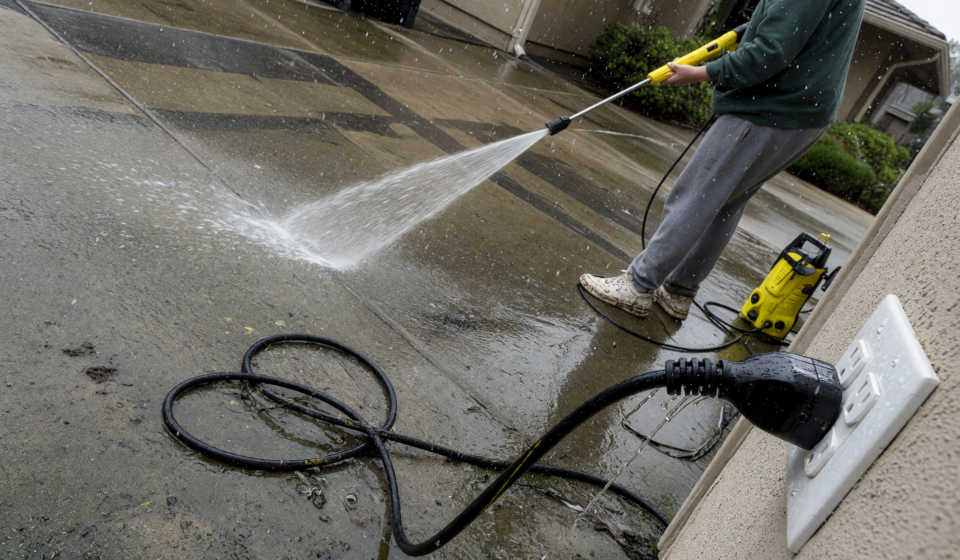
GFCI-Less Pressure Washers Recalled Over Shock and Electrocution Risk
On August 20, 2026, the U.S. Consumer Product Safety Commission (CPSC) and importer Workbless announced a pressure washer recall covering about 2,200 electric pressure washers in the United States — plus roughly 657 more in Canada — because the machines lack a built-in ground-fault circuit-interrupter (GFCI) and an adequately long power cord. Together, those shortcomings create what regulators call a risk of “serious injury or death” from shock and electrocution. No injuries have been reported so far, but the CPSC is urging owners to stop using the units immediately.
What happened
The recall (number 26-715) covers Workbless electric pressure washers in models WB0301 and WB0302. According to the CPSC notice, the machines “lack an integral ground-fault circuit-interrupter (GFCI) and an adequate-length power cord,” a combination that leaves users exposed to electrical faults while spraying water. The pressure washers were sold from April 2025 through July 2026 for between $97 and $140 at a wide range of major retailers, including Amazon.com, Best Buy, Kohl’s, Lowe’s, Overstock, Target, and Walmart. The importer is listed as Guangzhou Ao Lian Ya Wang Luo Ke Ji You Xian Gong Si, doing business as Workbless, of China.
Because the units were carried by so many mainstream stores, the recalled washers likely reached households that would never think to check a pressure washer for a safety defect. That broad distribution is exactly why a low unit count can still matter: a single GFCI-less machine used on a wet driveway is enough to cause a tragedy.
Why a missing GFCI matters for safety
A pressure washer is one of the few consumer tools that deliberately combines mains electricity with a torrent of water, often on a wet surface where the operator is standing barefoot or in soaked shoes. That is the worst-case scenario for electrical safety. A ground-fault circuit-interrupter is the component designed for exactly this situation: it constantly compares the current flowing out to the current returning, and if it detects even a few milliamps leaking to ground — for example, through a person — it cuts power in a fraction of a second, fast enough to prevent a fatal shock.
Portable electric pressure washers sold in the United States are expected to carry integral GFCI protection built into the plug or power cord for this reason. When that protection is absent, a frayed cord, a cracked internal seal, or water intrusion into the motor can energize the frame or the water stream itself, and there is nothing to interrupt the current before it reaches the user. The second half of the Workbless defect — a power cord that is too short — compounds the danger, because it tempts owners to reach for household extension cords that are not rated for wet outdoor use, adding another point of failure.
- The hazard: shock and electrocution from a machine that mixes electricity and water without a fast-acting cutoff.
- The missing safeguard: an integral GFCI that trips within milliseconds when current leaks to ground.
- The compounding factor: a too-short cord that encourages unsafe extension-cord workarounds.
- Who is exposed: anyone operating the washer on a wet surface — driveways, decks, patios, and vehicles.
What you should do
If you own a Workbless WB0301 or WB0302 electric pressure washer, stop using it now — do not wait for it to fail. The CPSC and Workbless are offering a full refund. To claim it, unplug the washer, cut the power cord in half, and email a photo of the destroyed unit to service@workbless.net; the company will then process your refund. You can also reach Workbless at 833-725-3151 (9 a.m. to 5 p.m. Pacific, Monday through Friday) or visit workbless.net/recall for instructions. After documenting the cut cord, dispose of the machine so no one can put it back into service.
What to do. Stop using any recalled Workbless pressure washer immediately, cut the unplugged power cord in half, photograph it, and email service@workbless.net for a full refund. Never run any electric pressure washer that does not have a GFCI on its plug or cord.
The lesson extends to every electric pressure washer, not just the recalled ones. Before your next job, look for a GFCI module molded into the plug — a small block with “test” and “reset” buttons. If it is not there, do not use the machine. Even with a GFCI-equipped washer, plug it into a GFCI-protected outlet when possible, inspect the cord for cracks or exposed wire before each use, keep connections up off wet ground, and never bypass the plug with a standard indoor extension cord.
Context: a wider crackdown in 2026
The Workbless action is not an isolated case. Through 2026 the CPSC has repeatedly flagged low-cost, imported electric pressure washers for the same defect — a missing GFCI. On April 2, 2026, the agency issued direct stop-use warnings for both SEN-QII and Vlaseo pressure washers sold on Amazon, again citing the absence of GFCI protection and a resulting “risk of death or serious injury due to electrocution and shock.” In those cases the CPSC noted that the sellers would not cooperate: SEN-QII “refused to agree to an acceptable recall,” and Vlaseo “has not responded to requests for a recall.” When a firm will not act, the agency’s warning is the consumer’s only notice, which is why these alerts are worth taking seriously even without a formal refund program attached.
The pattern points to a durable buyer-beware reality in the online marketplace: inexpensive tools from overseas sellers can reach American porches without the safety features that domestic standards assume are present. For pressure washers specifically, the single most protective habit is simple and free — confirm the GFCI before you pull the trigger, every time. Expect the CPSC to keep posting recalls and warnings in this category; checking cpsc.gov before buying or before the season’s first wash-down is a smart, low-effort safety step.
Disclaimer: This article is for general safety information only and is not legal, medical, or professional advice. Product details, unit counts, and remedies reflect the CPSC notices available at publication and may be updated. Always follow the official CPSC recall instructions and the manufacturer’s guidance for your specific model.
Sources: CPSC — Workbless Pressure Washers Recall (26-715); CPSC — SEN-QII Pressure Washer Warning; CPSC — Vlaseo Pressure Washer Warning.