Paintball and Airsoft Eye Protection: ASTM F2879 Masks Explained
A paintball leaves the barrel at close to 300 feet per second, and an airsoft BB can travel even faster from a hot gun. That is roughly the speed of a car on the highway, aimed at your face, dozens of times per game. Everyday sunglasses, shop safety glasses, and swim goggles were never built for that kind of energy, which is exactly why serious paintball eye protection lives in its own category of gear governed by dedicated American test standards. Get it right and a direct hit is a story you laugh about later. Get it wrong and it can end in a permanent injury.
This guide breaks down the two standards that actually matter for these sports: ASTM F1776 for paintball and ASTM F2879 for airsoft. We will explain what each one tests, why a full-seal goggle or full-face mask beats a pair of impact glasses, how thermal lenses and anti-fog coatings tie into safety, and how to read a label so you buy gear a field referee will actually let you wear. No jargon for its own sake, just the reasoning behind the rules so you can make a smart call at the shop.
Why Everyday Glasses and Shop Goggles Fall Short
It is tempting to assume that any lens marked for impact will do the job. It will not. Industrial safety eyewear built to the ANSI Z87.1 standard is designed around workplace hazards such as flying chips, grinding debris, and small hard fragments. Those are real dangers, but they are not the same as a large, liquid-filled paintball that deforms and dumps its energy across the lens, or a stream of BBs hunting for any gap around the frame. A pair of glasses can pass a shop-floor test and still fail on the field for two simple reasons: coverage and retention.
- Coverage gaps: Open-sided glasses leave your temples and the area under your eyes exposed, and BBs are notorious for finding those angles.
- Projectile type: Paintballs are large and rupture on contact, transferring force differently than the small hard objects industrial lenses are tuned for.
- Retention: A hit can knock unstrapped glasses clean off your face, leaving your eyes bare for the next shot.
- Debris after a break: Untested lenses and bare mesh can shatter or let fragments through, sending pieces toward the eye.
Read this before you buy. An ANSI Z87.1 or Z87+ marking means eyewear passed an industrial impact test. It does not mean the gear was validated for paintball or airsoft velocities. For those sports, look specifically for ASTM F1776 (paintball) or ASTM F2879 (airsoft), and always follow the posted rules at your local field.
The Two Standards Behind Real Paintball Eye Protection
Both standards come from ASTM International, a long-established American standards organization that publishes consensus test methods across countless industries. For our world, two documents do the heavy lifting. Proper paintball eye protection is defined by ASTM F1776, the specification for eye and face protective devices used in paintball. Airsoft has its own companion document, ASTM F2879, written specifically for the lighter, faster projectiles that sport uses. They share a family resemblance, but each is tuned to the projectile and play style of its game.
- ASTM F1776: The paintball standard. It validates gear against actual paintballs fired from real markers at gameplay velocities, and it covers face and ear protection, not just the lens.
- ASTM F2879: The airsoft standard. It addresses the small plastic BBs used in airsoft, which behave differently on impact and demand a tight seal against tiny projectiles.
- ANSI Z87.1: The industrial baseline. Useful context, sometimes referenced by fields, but not a substitute for the sport-specific specs above.
👉 Shop ASTM F1776-rated paintball mask / ASTM F2879-rated airsoft goggle on Amazon (Ad — as an Amazon Associate, we earn from qualifying purchases.)
What ASTM F1776 Actually Tests for Paintball
What makes the paintball standard reassuring is that it does not test with a generic steel ball in a lab vacuum. It uses the same ammunition and markers you meet on the field. The lens has to stop a paintball from penetrating, and just as important, the lens must stay locked in its frame rather than popping loose on a hard hit. A lens that holds a paintball but then dislodges is no protection at all, so retention is treated as seriously as impact resistance.
- Penetration resistance: The lens must stop paintballs fired at real gameplay velocities, generally in the range of a few hundred feet per second.
- Lens retention: The lens cannot dislodge from the frame on impact, because a popped lens exposes the eye instantly.
- Optical quality: The standard also checks field of view, clarity, and distortion, treating good vision as a safety requirement rather than a luxury.
- Coverage classes: The specification recognizes different protection types, with the fuller types adding face and ear coverage for angled and side shots.
What ASTM F2879 Adds for Airsoft
Airsoft flips the problem around. Instead of a large ball that ruptures, you face a small, hard plastic BB that can slip through the smallest gap and can shatter on a hard surface, throwing fragments. ASTM F2879 was written for exactly this threat. The emphasis lands hard on a complete seal around the eyes and on lens integrity under repeated small-projectile impacts. This is why the airsoft world leans so heavily on fully sealed goggles rather than open glasses, and why loose mesh eye protection is a subject of ongoing debate at many fields.
- Full seal focus: The standard and field culture both prioritize goggles that leave no gap for a BB to sneak through.
- Small-projectile impact: Testing reflects the fast, lightweight BBs airsoft uses, which behave differently than paintballs.
- Fragment risk: Because BBs can shatter, lens toughness and a closed seal matter for keeping debris out of the eye.
- Field enforcement: Many airsoft venues require rated, sealed eye protection and inspect it at check-in, so buying to the standard saves you a headache at the door.
👉 Shop full-seal airsoft goggles with retention strap on Amazon (Ad — as an Amazon Associate, we earn from qualifying purchases.)
Full-Seal Goggles Versus Full-Face Masks
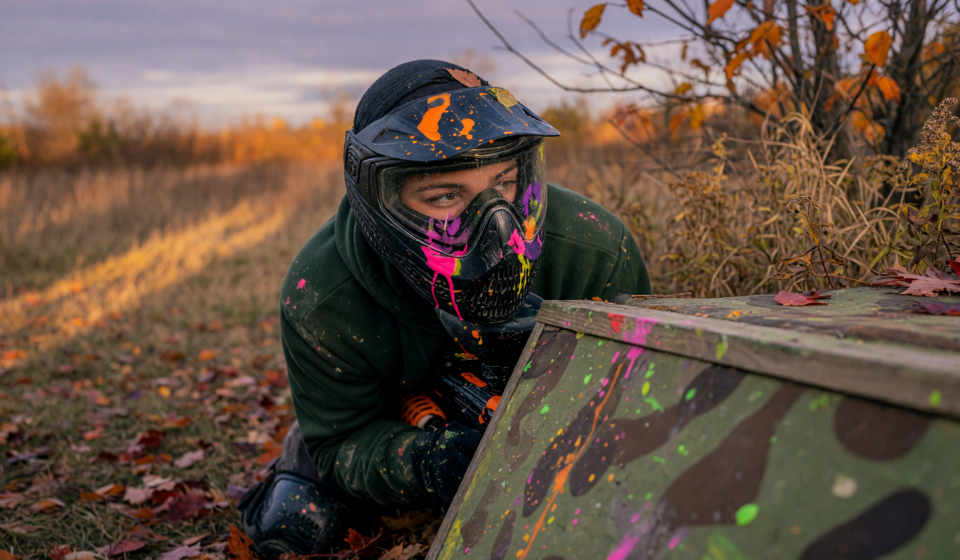
Once you are shopping to the right standard, the next decision is how much of your head you want to cover. Airsoft players often run a sealed goggle paired with a lower-face mesh guard, which is light and low-profile. Paintball players usually reach for a full-face mask that wraps the eyes, nose, mouth, and ears in a single unit. Neither is automatically better; the right choice depends on your sport, the ranges you play, and your tolerance for weight versus coverage.
- Full-face paintball masks: Maximum coverage in one piece, protecting ears and mouth from close-range and angled hits. A direct paintball to an unprotected mouth genuinely hurts.
- Sealed goggles plus lower guard: Common in airsoft for a lighter feel and a wider field of view, with a separate mesh or hard guard for the lower face.
- Weight and comfort: Fuller masks trade a little bulk and airflow for more protection, which matters over a long day.
- Consistency: Whatever you pick, it needs to stay sealed and in place from the first whistle to the last, even after you take a hit.
👉 Shop full-face paintball mask on Amazon (Ad — as an Amazon Associate, we earn from qualifying purchases.)
Thermal Lenses, Anti-Fog, and Why Clarity Is a Safety Feature
Here is a point new players underestimate: a fogged lens is a safety problem, not just an annoyance. When you cannot see, you are tempted to lift your mask mid-game, and lifting your mask is how the worst eye injuries happen. That is why the paintball standard checks optical clarity in the first place, and why thermal lens technology is worth the money. A dual-pane thermal lens uses two layers with an air gap between them, so the inner surface stays warm and resists the fogging that a single lens develops the moment you start sweating.
- Dual-pane thermal lenses: Two layers with a sealed air gap dramatically cut fogging, keeping your view clear during hard play.
- Anti-fog coatings and fans: Coatings help, and some masks add small fans, but the thermal design is the workhorse.
- Tint for conditions: Choose lens tint for your light, clear or low-light lenses for dusk and indoors, mirrored or smoked for bright sun.
- Never lift to clear it: If a lens fogs, leave the play area to clear it. Lifting a mask in a live zone is the single most dangerous habit in these sports.
👉 Shop dual-pane thermal replacement lens / anti-fog lens on Amazon (Ad — as an Amazon Associate, we earn from qualifying purchases.)
How to Read the Label and Stay Legal at the Field
Standards only help if you can spot them, and the marking is usually printed on the frame, the strap, or the packaging. Before you buy, confirm the gear names the standard that matches your sport, then confirm your local field allows it. Fields set their own rules, and a referee’s word is final on game day. As a broad consumer-safety backdrop, the U.S. Consumer Product Safety Commission oversees the safety of products sold to the public, but the sport-specific ASTM specs are what tell you a mask was built for incoming fire.
- Match the sport: Look for ASTM F1776 on paintball gear and ASTM F2879 on airsoft gear, not just a generic impact marking.
- Check field rules first: Call ahead or read the venue’s site; some fields require specific ratings and inspect eyewear at check-in.
- Inspect before every game: Look for cracks, crazing, worn straps, and a lens that seats firmly in the frame.
- Keep it sealed and strapped: A rated mask only protects you when it is worn correctly and stays put during a hit.
Fit, Straps, and When to Replace a Mask
A mask certified to any standard is only as good as its fit. It should sit snugly with no gaps at the temples or under the eyes, and the strap should hold it firmly without you having to cinch it painfully tight. Try before you buy when you can, because face shapes vary and a mask that seals beautifully on one person may leave a gap on another. And treat your lens as a wear item: like a bike helmet after a crash, protective eyewear that has taken a serious hit or shows damage should be retired, not gambled on.
- Snug, gap-free seal: No daylight at the temples or cheeks, and comfortable enough to wear for hours.
- Secure retention strap: Wide, grippy, and adjustable so the mask stays put through movement and impacts.
- Retire damaged lenses: Cracks, deep scratches, or a hard direct hit mean it is time for a replacement lens or mask.
- Store it right: Keep lenses in a bag or case away from grit and heat so coatings and seals last.
The Bottom Line
Eyes do not heal like bruises, and there is no do-over on a bad hit. The good news is that the guesswork has already been done for you: ASTM F1776 for paintball and ASTM F2879 for airsoft exist precisely so you do not have to wonder whether your gear can take a shot at game speed. Buy to the standard that matches your sport, choose a full-seal goggle or full-face mask with a good thermal lens, keep it clean and correctly fitted, and respect the field’s rules and your referee. Do that, and the only thing you will remember about a face shot is the sound it made. Play hard, protect your eyes, and they will carry you through many more games to come.
Disclaimer: This article is provided for general educational purposes only and does not constitute safety, medical, or professional advice. Standards and product specifications change over time, and field rules vary by venue. Always follow the manufacturer’s instructions, the current version of the relevant standard, and the posted rules and staff guidance at your local field. When in doubt, consult a qualified professional and confirm that any eye protection is appropriate and undamaged before use.
Sources: ASTM International, Standard Specification for Eye Protective Devices for Paintball Sports (ASTM F1776); ASTM International, Standard Specification for Eye Protective Devices for Airsoft Sports (ASTM F2879); American National Standards Institute (ANSI Z87.1 occupational and educational eye and face protection); U.S. Consumer Product Safety Commission (consumer product safety oversight).